Commercial Insurance Claim Guide for Business Owners: Steps, Deadlines, and What to Do First
A commercial insurance claim is a formal request you make to your insurer to recover financial losses after a covered event — like storm damage, fire, theft, or a customer injury on your property. For businesses facing roof leaks, hail damage, or wind loss, fast action and accurate documentation are the two biggest drivers of claim success. If you need help from a trusted commercial roofing company in Northwest Arkansas, having the right local partner involved early can improve documentation, speed inspections, and reduce costly secondary damage.
The reality is sobering: many small businesses file at least one commercial insurance claim within their first ten years of operation. One unexpected storm, fire, or break-in can bring operations to a complete halt. For businesses in Northwest Arkansas, where severe weather is a recurring threat, knowing how to move quickly and correctly through the claims process is not optional — it is essential to survival.
That is exactly why this guide exists. Whether you are dealing with roof damage from a hail storm or navigating a liability claim after a customer was injured on your property, the steps you take in the first 72 hours can make or break your recovery. Our commercial roofing services are built around helping business owners protect their property and navigate the claims process with confidence.
I’m Rex Wisdom, owner of Heritage Roofing & Repair, and over the past 50-plus years our family business has helped countless commercial property owners in Berryville and Northwest Arkansas document storm damage, work alongside insurance adjusters, and file a successful commercial insurance claim to restore their roofs and get back to business. In the sections ahead, I’ll walk you through exactly what to do — step by step — so you are never left guessing.
Commercial insurance claim terms explained:
The Step-by-Step Commercial Insurance Claim Process

Navigating the commercial insurance claim journey can feel like learning a second language while your building is under water or your roof is missing shingles. However, most claims follow a predictable lifecycle. Understanding this lifecycle—often referred to as demystifying the insurance claim journey—is the first step toward a fair settlement.
The process begins with the First Notice of Loss (FNOL). This is the official notification you provide to your insurance company or agent. Once this is logged, the insurer performs an Initial Review to confirm your policy was active at the time of the incident and that the type of damage (peril) is generally covered.
Next comes the Adjuster Assessment. An insurance adjuster will be assigned to your case to inspect the physical damage, interview witnesses, and review your documentation. Based on their findings, the insurer moves to Settlement Evaluation, where they calculate the payout based on your policy limits and deductibles. The final stages are Resolution and payment, allowing you to file a business insurance claim | III effectively and get back to work.
Reporting Speed and State Deadlines
Time is your greatest enemy after a business loss. In Arkansas, insurance regulations are designed to keep the process moving. Specifically, the Arkansas 15-day rule requires insurance companies to acknowledge your claim and provide the necessary forms within 15 working days of receiving your notice.
While you have a legal window, industry experts recommend a much tighter 48-72 hour window for reporting incidents, especially for vehicle collisions or property damage. Prompt notification ensures that evidence doesn’t disappear and that you meet the “as soon as practicable” requirement found in most policies. When you call, have your policy numbers and a brief description of the event ready. For those looking ahead, our roof insurance guide 2025 highlights how early reporting can prevent secondary issues like mold or structural rot.
Initial Review and Adjuster Assignment
Once you’ve reported the loss, a claim representative will be your primary point of contact. Their job is coverage verification—checking the fine print to see if wind, hail, or fire is an “included peril” in your specific plan.
Typically, you can expect an adjuster assignment within 24-48 hours of your initial call. This adjuster is responsible for inspection scheduling. It is highly beneficial to have your contractor present during this inspection. We often work directly with roofing contractors and insurance adjusters to ensure that no damage is overlooked, as an adjuster’s quick walkthrough might miss subtle structural issues that a roofing specialist would catch.
Immediate Actions to Protect Your Business After a Loss
What you do in the minutes and hours following an accident is critical. Your insurance policy likely contains a “duty to mitigate” clause. This means you are legally obligated to mitigate damage—taking reasonable steps to prevent the situation from getting worse.
If a storm blows a hole in your warehouse roof, you shouldn’t wait for the adjuster to arrive before covering it. Making temporary repairs is expected and often reimbursed as part of the claim. Furthermore, if the loss involves theft, vandalism, or a vehicle accident, you must obtain police reports. This creates a third-party record of the event that is difficult for insurers to dispute. Always focus on evidence preservation; do not throw away damaged equipment or debris until the adjuster has seen it. You can find more tips on this in our roof damage insurance guide and through resources like Commercial Property Insurance Claims | File A Claim.
Securing the Premises
Securing your property is about safety and financial protection. Tarping roofs and boarding windows are the most common immediate actions for commercial properties in Northwest Arkansas. If your facility is open to the public, mark off hazardous areas with caution tape.
Safety first is the rule of thumb. Do not enter a structurally compromised building or attempt to fix electrical issues yourself. By preventing secondary loss—such as rain damaging your interior inventory after the initial wind event—you demonstrate to the insurer that you are a responsible policyholder. This proactive approach is a key part of claiming your roof: how to get the assistance you deserve.
Essential Documentation for a Successful Claim
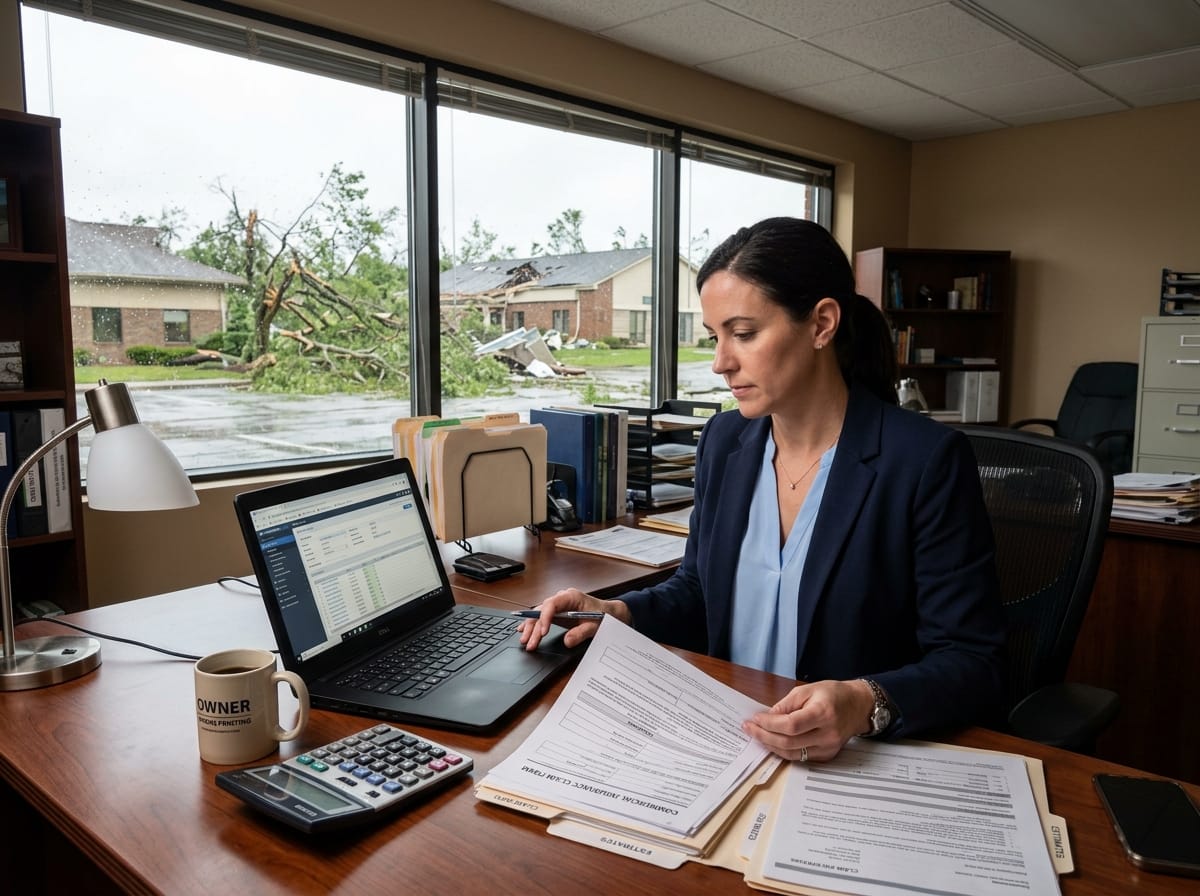
The “Proof of Loss” is perhaps the most important document in your commercial insurance claim. This is a formal, often notarized, statement where you swear to the amount of money you are requesting. Most policies have a strict 30-60 day deadline for submitting this form after the insurer requests it.
To support your proof of loss, you will need:
- Detailed Inventory Lists: A line-by-line account of everything lost.
- Financial Records: Especially important for business interruption claims.
- Repair Bids: At least two independent estimates from reputable local contractors.
Our insurance claim support complete guide provides templates and checklists to help you stay organized during this paperwork-heavy phase.
Gathering Evidence for Your Commercial Insurance Claim
In insurance, if it isn’t documented, it didn’t happen. Use your smartphone to capture extensive photo evidence and video walkthroughs of the entire site, including damaged machinery and inventory. This level of detail is invaluable when you are filing roof insurance claim guide and trying to prove the value of your lost assets. Beyond visual proof, you need a paper trail. Save every receipt for temporary repairs, plywood, tarps, and even extra security guards if your building was left open. Maintain updated asset lists and equipment logs that detail the make, model, and age of any machinery involved. Also, keep copies of incident reports or witness statements from employees who saw the event occur. This comprehensive approach is detailed in our roofing insurance claims ultimate guide.
Managing a Liability Commercial Insurance Claim
If a customer is injured on your property, the process shifts slightly. A liability commercial insurance claim involves third-party involvement, meaning the insurer is defending you against someone else’s demand for payment.
Expect a thorough legal review and a deep dive into fault determination. Did the customer slip because of a roof leak we didn’t fix? Or was it an unavoidable accident? Working with insurance claim specialists can help you navigate the complexities of liability and protect your business’s reputation.
Navigating Adjusters, Denials, and Business Interruption
It is important to understand who the people involved in your claim actually work for. An Insurer Adjuster is employed by the insurance company to protect their interests. A Public Adjuster, on the other hand, is someone you hire to represent you.
| Feature | Insurer Adjuster | Public Adjuster |
|---|---|---|
| Employer | The Insurance Company | You (The Policyholder) |
| Cost | Included in your premium | Percentage of settlement (often 10-15%) |
| Goal | Minimize the insurer’s payout | Maximize your settlement |
| Expertise | General insurance policy | Detailed damage estimation |
When you receive settlement offers, do not feel pressured to sign immediately. If the offer is too low, you can send response letters with additional evidence or contact state regulators if you believe the insurer is acting in bad faith. If you find yourself in this position, consult our guide on what to do if insurance denied roof claim.
Business Interruption and Civil Authority
If your business has to close due to damage, Business Interruption coverage can be a lifesaver. However, it often comes with a 72-hour waiting period before benefits kick in. Civil Authority coverage is a specific subset that applies when the government prohibits access to your area (like after a major tornado or flood), provided there is physical damage within a 1-mile radius of your property.
To claim these benefits, you must provide net income proof (tax returns and P&L statements) and records of ongoing operating expenses like payroll and rent. Learn more in our commercial roof insurance claims guide.
Why Claims Get Denied
Understanding why do insurance companies deny roof claims can help you avoid the same fate. The most common reasons include:
- Exclusions: The damage was caused by something not covered (like a flood if you only have fire insurance).
- Late Filing: Missing the reporting deadlines.
- Lack of Evidence: Not having photos or receipts to back up the claim.
- Maintenance Issues: The insurer claims the roof failed because it was old and poorly maintained, not because of a storm.
Frequently Asked Questions about Commercial Claims
How long does it typically take to process and settle a commercial insurance claim?
Most straightforward property claims are processed within 30 days, though complex liability or large-scale catastrophe claims can take several months to reach a final resolution. The complexity of the investigation and the speed of your documentation play a huge role in the final timeline.
Will filing a commercial insurance claim increase my business insurance premiums?
Filing a claim can impact your risk profile, potentially leading to a premium increase; however, a single weather-related claim is less likely to cause a spike compared to multiple liability or theft claims. Insurers look at “frequency and severity.” If you file three small theft claims in one year, you are seen as a higher risk than a business that files one large wind damage claim every decade.
What are the biggest mistakes small businesses make when filing claims?
The most common errors include delaying the report, failing to document damage before making permanent repairs, and accepting the first settlement offer without obtaining independent repair estimates. Another major mistake is discarding damaged property before the adjuster can inspect it, which can lead to a denial of that portion of the claim.
Conclusion
At Heritage Roofing & Repair, we’ve seen how a well-handled commercial insurance claim can turn a potential disaster into a successful renovation. With over 50 years of trusted experience in Berryville, AR, and across Northwest Arkansas, we pride ourselves on dependable, quality craftsmanship. We specialize in storm damage repair and helping local businesses navigate the insurance maze. don’t go it alone: how to get help with your insurance claim.
For businesses in Northwest Arkansas, working with a local partner who understands the regional climate and insurance landscape is vital. If your facility has suffered damage, contact the professionals at Heritage Roofing & Repair for a comprehensive inspection and claims assistance.
Heritage Roofing & Repair
3458 Arkansas State Hwy 221, Berryville, AR 72616
(870) 654-1164