Why Every Berryville Homeowner Needs a Storm Damage Assessment Plan
Berryville storm damage assessment is the process of systematically inspecting your property after a severe weather event to identify visible and hidden damage — and in Northwest Arkansas, it’s not a question of if you’ll need one, but when.
If your home or business has just taken a hit, the storm damage repair services at Heritage Roofing & Repair are built for exactly this situation. We provide rapid inspections to identify issues before they escalate into costly structural repairs and secondary damage like mold growth.
I’m Rex Wisdom, owner of Heritage Roofing & Repair, a family-owned business with over 50 years of collective experience providing Berryville storm damage assessment and roof restoration across Northwest Arkansas. In the sections below, I’ll walk you through everything you need to know — from reading the local risks to navigating your insurance claim — so you can protect your home and move forward with confidence.
Understanding Local Risks and Historical Weather Patterns
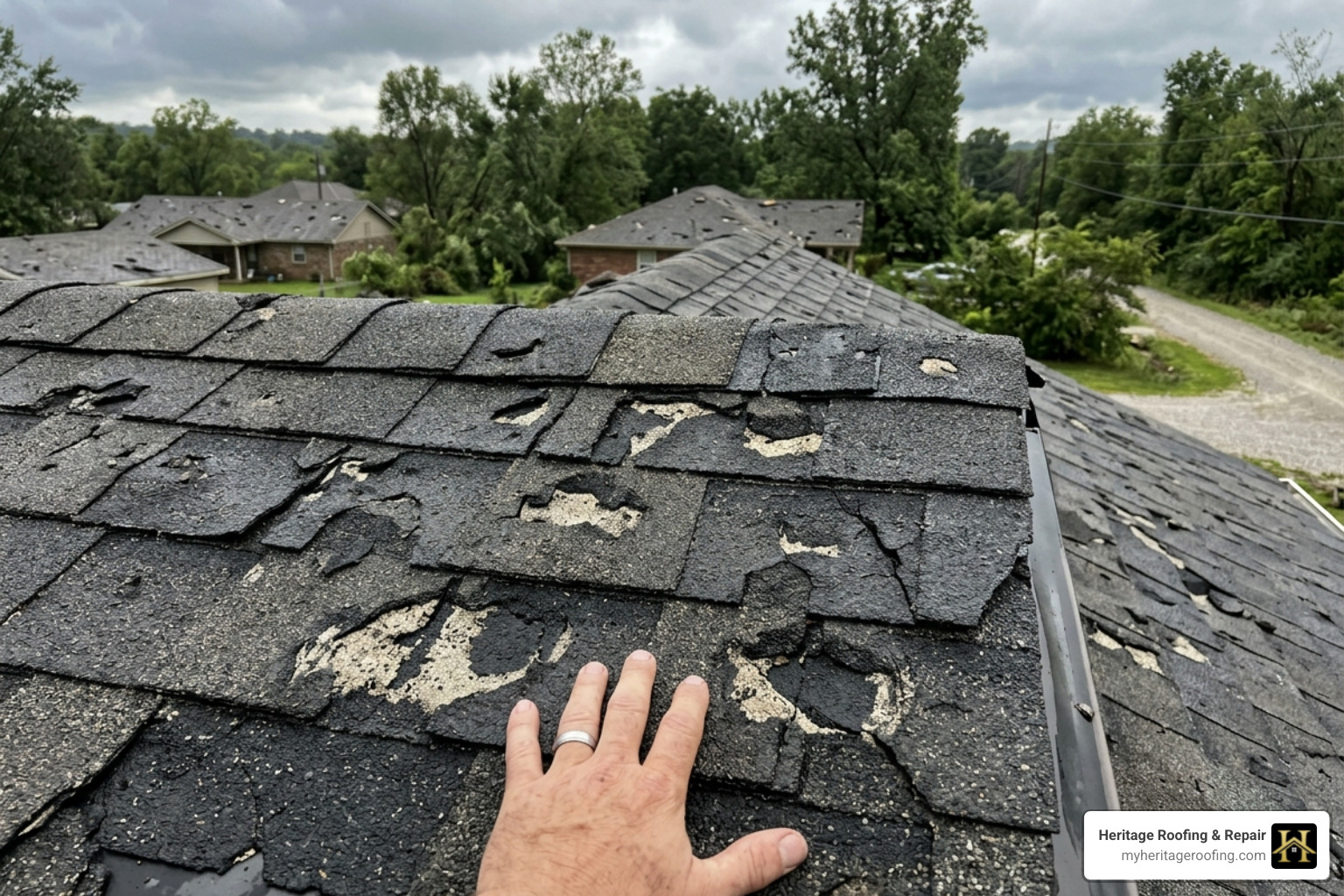
When we talk about a Berryville storm damage assessment, we have to look at the specific environmental factors that make Carroll County unique. Our area isn’t just dealing with “bad weather”; we are dealing with a specific set of climate risks that can compromise the structural integrity of your home in minutes.
In May 2026, looking back at our recent history, the patterns are clear. Berryville faces a High Flood Risk score of 63%, primarily stemming from what experts call 500-year flood events. While many properties sit in FEMA floodzone X (meaning insurance isn’t always mandatory), the risk of localized flooding remains a serious threat to foundations and crawlspaces.
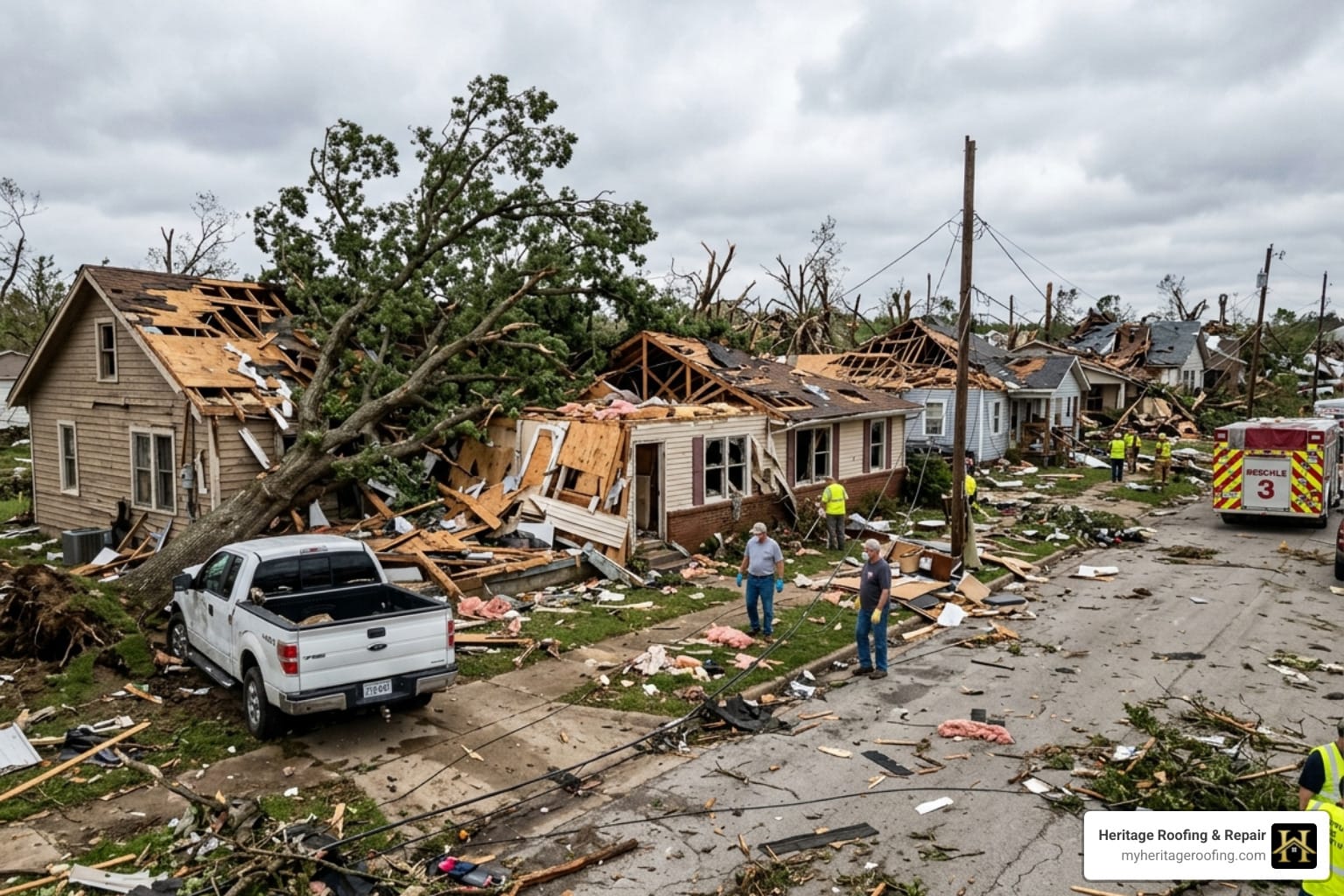
Wind and hail are the primary culprits for roof damage in our neck of the woods. High-velocity winds, like those that reached 70 mph in historical Carroll County events, can lift shingles and create “open doors” for water. We’ve seen the impact firsthand; in April 2023, storms caused major roof damage to a storage building at Berryville Middle School, and the Berryville mayor reports storm damage to school facilities frequently after these episodes. More recently, in March 2025, significant wind and hail events impacted thousands of properties across the region, reminding us that local storm damage is a persistent neighbor.
Historical Weather Patterns in Carroll County
To understand why your roof might be struggling, it helps to look at the data. According to the Storm Events Database – Event Details, Berryville has a history of thunderstorm wind events exceeding 61 knots (roughly 70 mph). At these speeds, even healthy, mature trees can be uprooted, often landing directly on residential structures.
Hail is another frequent visitor. Even 1.00-inch hail—about the size of a quarter—is enough to cause “bruising” on asphalt shingles. This bruising isn’t always visible from the ground, but it shatters the fiberglass matting underneath, leading to leaks months or even years down the line. For a full checklist of what to look for, refer to our hail damage roof repair guide.
Future Climate Risks and Flood Maps
Looking forward, the data suggests our weather isn’t getting any calmer. Reports from First Street indicate that Berryville residents should stay vigilant regarding both wind and water. The Berryville, AR Hurricane Map and Climate Risk Report highlights that while we aren’t on the coast, the remnants of tropical systems can bring intense rainfall and sustained high winds to Northwest Arkansas. Understanding these maps is the first step in long-term property protection.
Immediate Steps for a Comprehensive Property Inspection

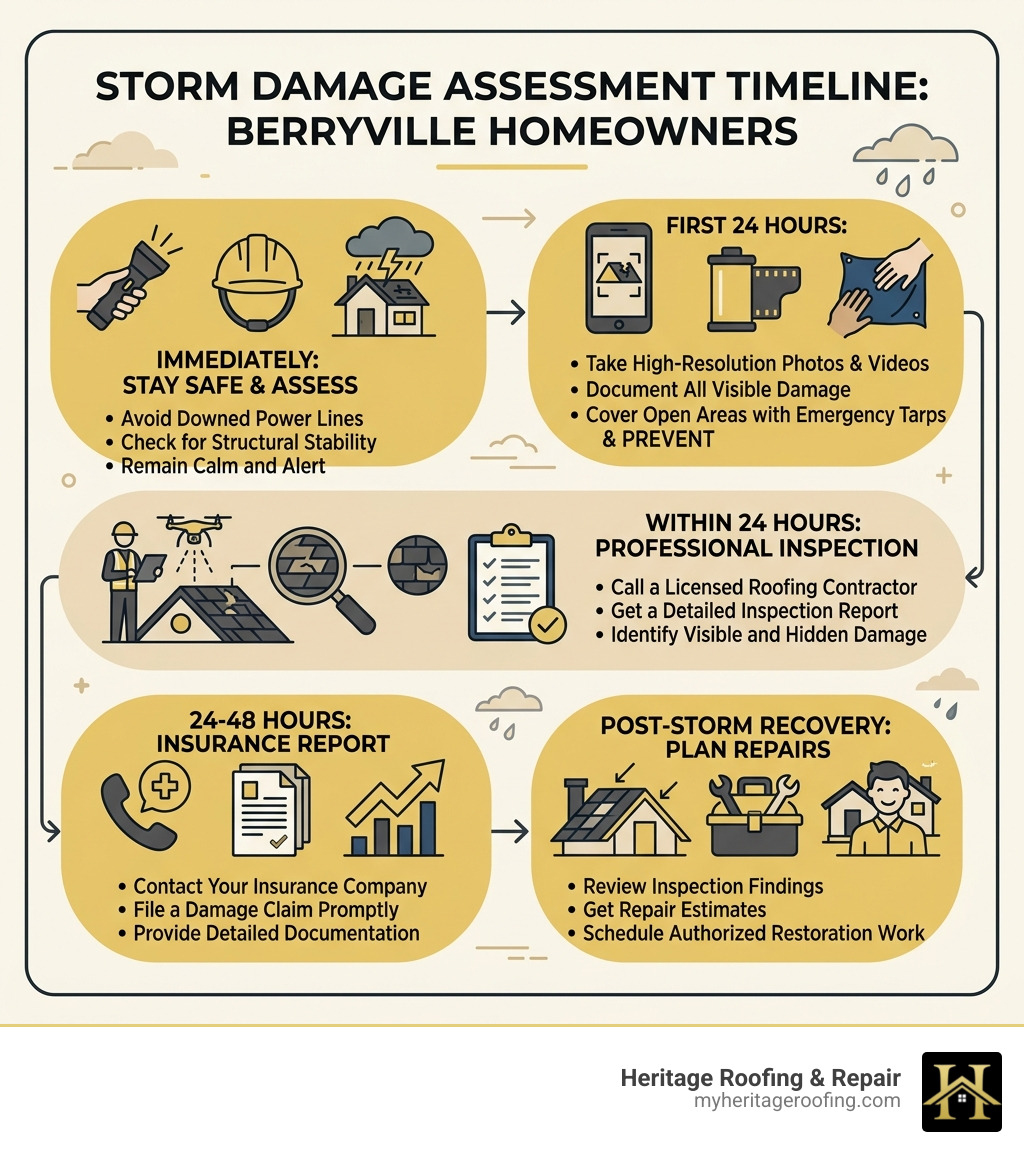
Once the clouds part and it’s safe to step outside, your priority is documentation. A thorough Berryville storm damage assessment starts with your smartphone.
- Safety First: Never walk on a roof that has been compromised by a storm, and stay at least 30 feet away from any downed power lines.
- Visual Inspection: Walk the perimeter of your home. Look for missing shingles, dented gutters, or cracked siding.
- Check the Attic: Often, the first sign of a roof leak isn’t on the ceiling; it’s damp insulation or “light leaks” visible in the attic.
- Emergency Mitigation: If you see a hole or a major leak, emergency tarping is essential to prevent the interior of your home from becoming a total loss.
For a deeper dive into what you should be looking for, check out our step-by-step guide to residential roof inspection.
The Critical 24-Hour Window for Berryville Storm Damage Assessment
In the restoration industry, we talk about the “Golden Hour.” Acting within the first 24 hours of a storm event can reduce your total repair costs by up to 40%. Why? Because water doesn’t sit still. In Berryville’s humid climate, mold spores can activate and begin growing within 24 to 48 hours of moisture intrusion.
Secondary damage—such as warped hardwood floors, ruined drywall, and electrical shorts—often costs more to fix than the initial roof leak. This is why we provide a complete guide to home storm repair to help you move quickly.
Professional Tools Used in Berryville Storm Damage Assessment
While a pair of binoculars is helpful, professional inspectors use high-tech tools to find what the naked eye misses. At Heritage Roofing & Repair, we utilize:
- Thermal Imaging: Infrared cameras detect “cold spots” behind walls, which indicate hidden moisture.
- Moisture Meters: These tools measure the exact percentage of water in building materials to ensure the structure is truly dry.
- High-Resolution Drones: These allow us to see the “bruising” and granule loss on steep slopes without risking further damage to the shingles.
If you’re wondering if your roof survived the latest round of hail, our homeowners guide to storm damaged roofing assessment explains these technical methods in simple terms.
Navigating Insurance Claims and Roof Restoration
The insurance process can feel like a second storm if you aren’t prepared. Statistics show that homeowners who work with professional advocates often see 20% higher payouts than those who go it alone. This isn’t because of “tricks,” but because professionals know how to document the damage using industry-standard software like Xactimate.
| Damage Type | Primary Indicators | Long-term Risk |
|---|---|---|
| Wind Damage | Lifted/missing shingles, creased tabs | Structural rot, interior leaks |
| Hail Damage | Granule loss, “bruising,” dented vents | Premature shingle failure, UV damage |
| Flood/Water | Damp insulation, water stains, mold | Respiratory issues, foundation shifts |
When filing your claim, the burden of proof is on the policyholder. This is why our ultimate guide to roofing insurance claims is such a vital resource for Berryville residents.
Identifying Hidden Structural Damage
Not all damage is as obvious as a fallen tree. Sometimes, the “shock” of a storm can cause subtle structural shifts. We look for signs of “racking” in the roof deck and other compromises to the home’s skeleton. A professional roof inspection service is the only way to ensure your property is truly secure.
Maximizing Your Insurance Settlement
Don’t let a “denied” letter be the final word. Often, adjusters miss the subtle signs of hail impact or wind uplift. Having a detailed estimate that breaks down material costs, labor, and local building code requirements is key to a fair settlement. For more on managing your deductible and coverage, see our homeowners insurance roof damage guide.
Local Resources and Emergency Response in Carroll County
Berryville has made great strides in emergency preparedness. The local government recently launched the Hyper Reach alert system to provide faster notifications than traditional TV alerts. After a major event, you might see the National Weather Service (NWS) teams in town confirming tornado paths or microbursts.
When the roads are blocked and the power is out, the community relies on local crews to clear downed trees and utility lines.
Contact Local Experts for Immediate Assistance
If you need a professional Berryville storm damage assessment, we are right here in the neighborhood. You don’t have to wait for “storm chasers” from out of state to show up.
Heritage Roofing & Repair
3458 Arkansas State Hwy 221, Berryville, AR 72616
Frequently Asked Questions
How long does the storm restoration process typically take?
The timeline depends on the severity of the damage. The drying phase—where we use industrial dehumidifiers to pull moisture from the air—typically takes 3 to 5 days. Actual roof repairs or replacements can often be completed in 1 to 2 days once the materials are on-site, though structural work can extend the project scope to several weeks.
Conclusion
A storm can be a traumatic event for any family or business owner, but you don’t have to navigate the recovery alone. Heritage Roofing & Repair is committed to providing Berryville with dependable, affordable, and high-quality craftsmanship. Whether you need a simple shingle repair or a complex commercial roof restoration, we are here to ensure the job is done right the first time.
Don’t wait for a small leak to become a massive headache. Schedule your Berryville wind damage roof assessment with our team today and let us help you protect your heritage.