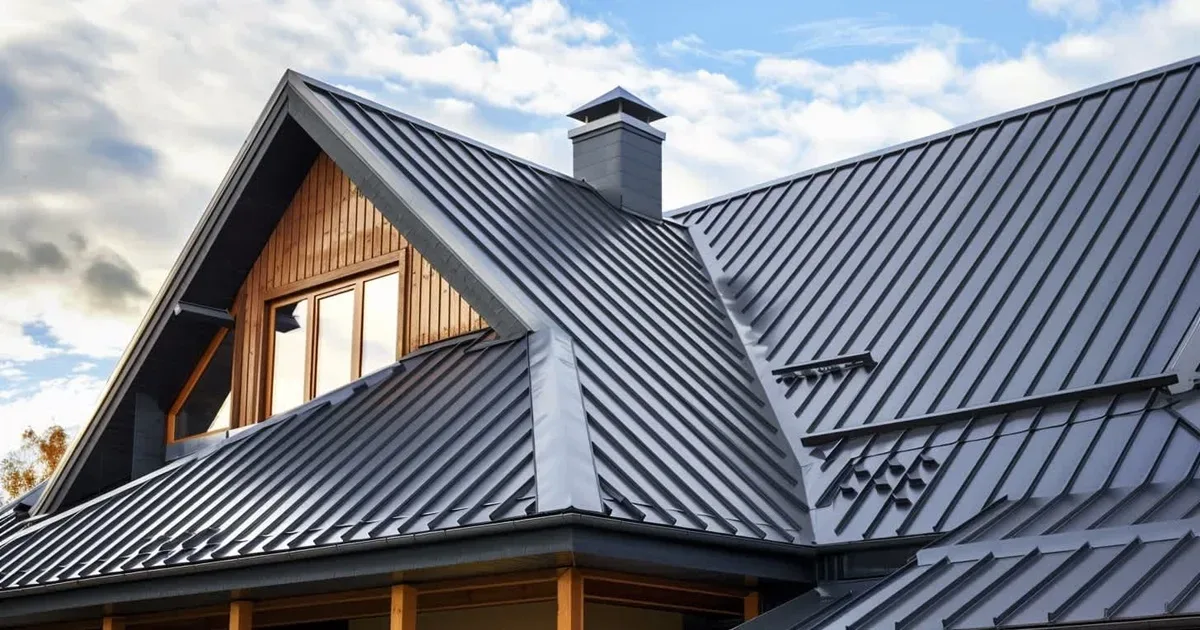
Most metal roof leaks start at a small number of places: the screws and their rubber washers, the laps and seams where panels overlap, the boots around vent pipes, and the flashing where the roof meets a wall, chimney or valley. The panels themselves rarely fail. If water is coming in, the cause is almost always one of those spots, and most can be repaired without replacing the roof.
At Heritage Roofing & Repair we have been working on roofs across the Ozarks since 1968, and metal roofs on homes, barns and shops are a big part of that. This guide walks through the four leak points we find most often, how to tell which one you have, and when it is time to call a roofer. If you would rather have someone look at it, every repair starts with a free roof inspection.
The quick answer
- Screws and washers: the most common cause on exposed-fastener roofs. Washers dry out and crack, and screws loosen or were driven wrong to begin with.
- Seams, laps and ridge caps: sealant and tape between overlapping panels wear out, and wind can push rain sideways through a gap.
- Pipe boots and penetrations: vent pipes, exhaust fans, skylights and HVAC curbs all cut a hole in the roof that has to be sealed.
- Flashing: where the roof meets a wall, a chimney, a valley or an eave, a bent or poorly sealed piece of trim lets water in.
- Not a leak at all: sometimes the water is condensation forming on the underside of the metal.
1. Screws and washers
Ribbed and corrugated metal roofs, the kind you see on a lot of barns, shops and older homes around Carroll and Boone counties, are held down with screws driven straight through the panel. Each screw has a rubber or neoprene washer under its head. That washer is what keeps the water out, and it takes a beating from the sun.
Over time the washer hardens, cracks or shrinks. Metal also grows and shrinks every day as it heats up and cools off, which slowly works the screw holes larger. On top of that, some screws were never set right: driven too tight so the washer split, too loose so it never sealed, at an angle, or into a spot that missed the wood or steel framing underneath. Sheffield Metals, a metal roofing supplier, lists failed fasteners first in its rundown of common metal roofing problems.
Signs it is a screw:
- Drips or stains that line up in a straight row across the ceiling or the underside of the roof.
- Rust rings or streaks around screw heads.
- Screws that are backed out, tilted or spin without tightening.
The right fix is to replace the failed screws, often with a slightly larger screw and a new washer so it bites into fresh material. Smearing caulk over the heads tends to hold for a season and then let go, and it hides the problem from the next person who looks at the roof.
2. Seams, laps and ridge caps
Every metal roof has places where one panel overlaps another. On exposed-fastener roofs those side laps and end laps are sealed with tape or sealant. When that seal ages, water can creep into the lap. Wind-driven rain makes it worse because it pushes water uphill and sideways into gaps that stay dry in a calm shower.
Standing seam roofs hide their fasteners and lock the panels together, so they leak far less often along the seams. When they do, it is usually at the ends of the panels, at the ridge, or where a seam was not fully closed or got bent.
Signs it is a seam: the leak shows up only in heavy or blowing rain, the stain sits near the ridge or at a spot where two panels meet, or you can see a lifted edge or a gap in the old sealant.
3. Pipe boots and other penetrations
Anything that pokes through the roof is a weak spot: plumbing vents, bathroom and kitchen exhaust fans, skylights, chimneys and rooftop HVAC units. On a ribbed metal roof the boot has to bend to follow the ribs, so it needs to be a boot made for metal and sealed and fastened around its whole base.
Rubber boots crack in the Arkansas sun the same way they do on a shingle roof. Our vent boot replacement guide covers how they fail and what a good replacement looks like.
Signs it is a boot or penetration: a stain on the ceiling right below a vent pipe or fan, wet insulation around the pipe in the attic, or a cracked or split collar you can see from the ground with binoculars.
4. Flashing at walls, chimneys, valleys and edges
Flashing is the trim that covers the joint where the roof meets something else. On metal roofs that means the sidewall trim along a wall, the flashing around a chimney, the valley where two roof slopes meet, and the eave and rake trim along the edges. If a piece was cut short, bent in a storm, or sealed only with caulk, water finds the gap.
Signs it is flashing: the stain sits along an inside wall, around the chimney, or under a valley, and it often gets worse when rain comes from one direction.
Is it a leak, or is it condensation?
Metal cools off fast on clear nights. When warm, damp air from the house or a closed-up shop touches the cold underside of the panels, it turns into water, the same way a cold glass sweats in summer. That water drips down and looks a lot like a leak, even on days with no rain at all.
Condensation is most common on cold mornings in late fall and winter, and on buildings with little or no underlayment, insulation or attic airflow. If the drips show up on dry mornings and spread across a wide area instead of one spot, airflow is the likely culprit. ENERGY STAR has a clear explanation of how attic ventilation works, and our post on attic ventilation problems covers what to look for in your own attic.
What about hail and storm damage?
Hail usually dents metal rather than punching through it, but a hard storm can loosen trim, tear a boot, or knock screws loose. If the leak started right after a storm, take photos before anything is moved and see our page on hail damage roof repair. Our roof insurance claim help page explains how we document storm damage for an adjuster.
What you can check safely from the ground
- Note when the leak happens: every rain, only heavy or windy rain, or on dry, cold mornings.
- Mark the stain on the ceiling and, if you can get in the attic safely, find the wet spot on the underside of the roof. Water often runs along a purlin or rafter before it drips, so the source is usually uphill from the stain.
- Look for a vent pipe, fan, chimney or wall directly above the wet area.
- From the ground, scan with binoculars for backed-out screws, rust around screw heads, cracked boots and bent trim.
- Take photos of everything you find. They help a roofer pinpoint the leak faster.
Please do not walk on a metal roof, especially when it is wet, frosty or dusty. It is slippery, and stepping in the wrong place can dent the panels or crack the seal around a screw.
When to call a roofer
Call when you cannot see the source, when the leak keeps coming back, when there are rows of loose or rusty screws, or when water is reaching insulation, wiring or ceiling drywall. A small leak on a metal roof is usually a small repair, but water that sits in a roof deck or attic for months turns into rot and mold.
On a metal repair our crews find where the water is actually getting in, then reseal, re-fasten or replace panels one at a time. You get photos and a written list of what was repaired. If the roof is past fixing, we will tell you plainly and walk you through the options on our metal roofing page. For other kinds of roofs, see our main roof repair page, and if water is pouring in right now, go to emergency roof repair.
Weighing metal against shingles for a future roof? Our post on standing seam vs shingles compares the two.
Metal roof leak FAQs
Do metal roofs leak more than shingle roofs?
No. A metal roof that was installed well rarely leaks through the panels. Most leaks come from screws, laps, boots and flashing, which are the parts that need checking as the roof ages.
Can I just put caulk or sealant on the screws?
It can stop a drip for a while, but it is not a lasting fix. When the washer under a screw has failed or the hole has worn larger, the screw needs to be replaced so it seals against fresh metal.
Why does my metal roof only leak in heavy or windy rain?
Wind pushes rain sideways and even uphill into laps, seams and trim that stay dry in a light rain. A leak that only shows up in a storm usually points to a seam, a lap or a piece of flashing.
Why is water dripping from my metal roof when it has not rained?
That is usually condensation. Warm, damp air meets the cold underside of the metal and turns into water. Better airflow or insulation under the roof is the fix, not a roof repair.
Do I need a new roof if my metal roof leaks?
Usually not. Most metal roof leaks are fixed by replacing screws, resealing laps, or replacing a boot or a piece of trim. Replacement makes sense when panels are rusted through across large areas or the roof keeps leaking after repairs.
Get a free inspection from a local crew
If your metal roof is leaking anywhere in Northwest Arkansas or the Missouri Ozarks, call or text our Berryville office at (870) 654-1164 or our Harrison office at (870) 293-0737, or book a free roof inspection. We will find where the water is getting in and tell you straight what it needs.