Wind Damage to Shingles Insurance: What Every Arkansas Homeowner Needs to Know
Wind damage to shingles insurance is something most homeowners only think about after a storm has already torn apart their roof. Here is what you need to know right now:
Quick Answer: Does homeowners insurance cover wind damage to shingles?
- Yes — standard homeowners insurance covers wind damage to shingles under dwelling coverage, as long as the damage was sudden and caused by a storm event.
- Covered events include thunderstorms, tornadoes, microbursts, and hurricanes.
- Not covered includes damage from wear and tear, neglect, or improper installation.
- Your payout depends on whether your policy pays Replacement Cost Value (RCV) or Actual Cash Value (ACV), and how large your deductible is.
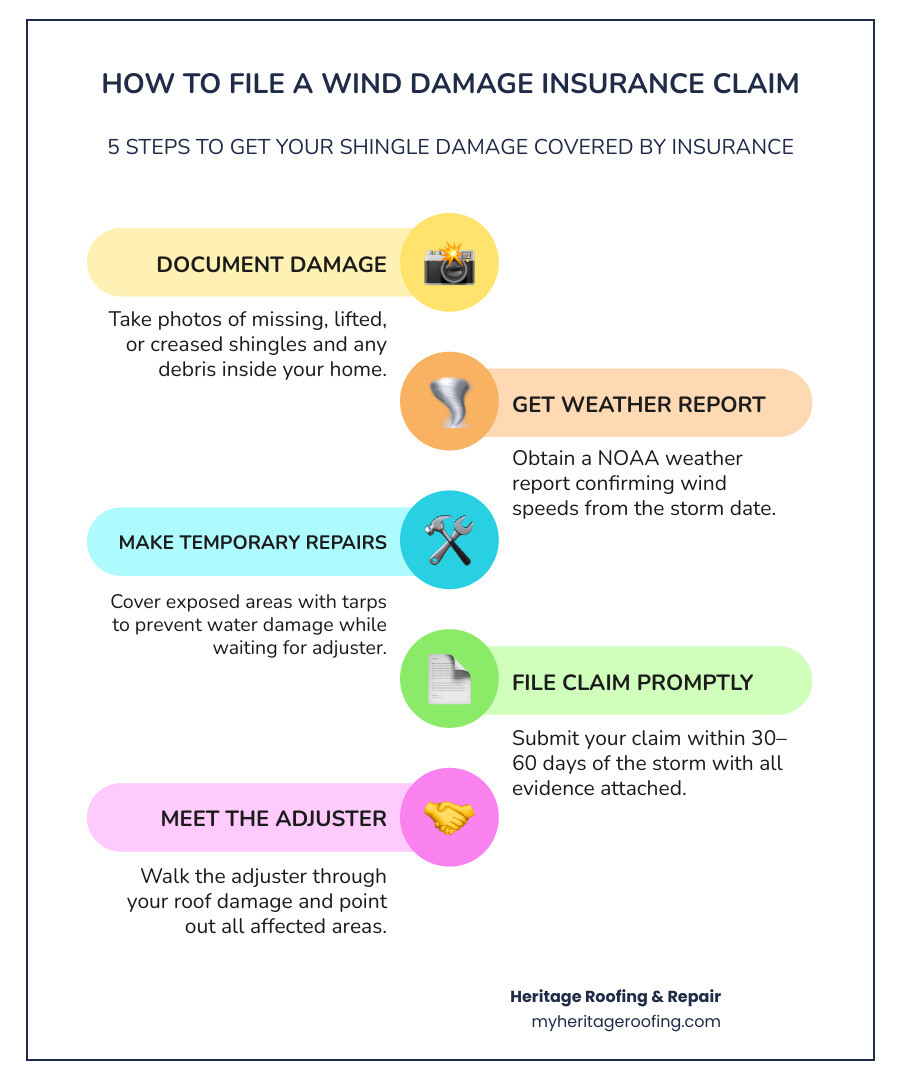
- File promptly — most policies have strict deadlines, often 30 to 60 days after the storm.
Wind and hail are the single most common cause of homeowner insurance claims in the United States, accounting for 40.7% of all property insurance claims according to the Insurance Information Institute (2022). That means more homeowners file claims for wind-damaged shingles than for fire, theft, or water damage combined.
Yet despite how common these claims are, many homeowners in Northwest Arkansas end up with denied claims, underpaid settlements, or confusing paperwork — often because they did not know what to document or how the process works.
That is exactly what this guide is here to fix. Our storm damage restoration services at Heritage Roofing & Repair have helped countless homeowners navigate this process from start to finish.
I’m Rex Wisdom, owner of Heritage Roofing & Repair, a family-owned roofing business with over 50 years of experience serving Berryville and Northwest Arkansas — including hands-on work with wind damage to shingles insurance claims after some of the region’s worst storms. If you have shingles on the ground or suspect hidden damage after a recent storm, you are in the right place.
Wind damage to shingles insurance further reading:
Understanding Wind Damage to Shingles Insurance Coverage
To understand how your insurance policy treats storm damage, we must first look at the foundation of your homeowners policy. Your home insurance policy is divided into different coverage types. The structure of your roof is covered under dwelling coverage, which protects the physical framework of your home against specific “covered perils.”
Windstorms, including tornadoes, microbursts, and severe thunderstorms, are standard covered perils in almost all standard homeowners policies (such as HO-3 and HO-5 policies). When high winds sweep through Northwest Arkansas, any resulting destruction to your shingles is legally classified as sudden and accidental damage.
This means that if a sudden gust of wind rips shingles off your roof, your insurance provider is obligated to help pay for the repairs, minus your deductible. However, this coverage is not a blank check. To secure a successful payout, you must establish a clear link between a specific weather event and the physical damage to your roof.
A professional assessment can help you navigate the complex language of your policy and document this link. You can read more about how these policies function in our Wind Damage Roof Guide.
Our Berryville Office Location
Heritage Roofing & Repair
3458 Arkansas State Hwy 221, Berryville, AR 72616
Phone: (870) 654-1164
Types of Wind Damage to Shingles Covered by Insurance
Wind does not interact with a roof in a single, uniform way. Instead, high winds create complex aerodynamic forces that stress your roofing system from multiple directions.
As wind hits the side of your home, it is forced upward, creating direct wind uplift on the edge of your roof. At the same time, as wind rushes over the ridge of your roof, it creates a pocket of negative pressure (suction) on the opposite, leeward side. This suction literally pulls the shingles upward from the roof deck.
When analyzing a storm-damaged roof, insurance adjusters look for clear directional damage patterns. If a storm blew in from the west, the western slope and the roof edges will typically show the most severe uplift, while the eastern slope may show suction-based lifting. Additionally, high winds often carry airborne debris, leading to debris impact damage where branches or flying objects have physically gouged or fractured the shingles.
Identifying Missing and Blown-Off Shingles
The most obvious sign of wind damage is direct shingle loss. When wind speeds reach 50 to 74 mph, they can easily tear older or improperly fastened shingles completely off the roof deck.
Once a shingle is blown off, it leaves the dark underlayment or the wooden roof decking completely exposed to the elements. This exposure is a ticking clock; without the protective shingle barrier, rainwater will quickly find its way through the nail holes and seams, leading to severe water infiltration, ruined insulation, and ceiling mold.
To learn more about what qualifies as physical storm damage under standard policy guidelines, check out this external resource on Wind Damage Roof Claims: What Qualifies.
The Hidden Threat of Lifted Shingles and Broken Seals
While missing shingles are easy to spot from the ground, the most dangerous type of wind damage is often completely invisible to the untrained eye. When high winds get underneath a shingle tab, they lift it upward, breaking the manufacturer’s self-sealing adhesive strip.
Once these broken adhesive seals occur, the shingle is permanently compromised. Even if the shingle settles back down and looks perfectly flat from the ground, it no longer has any wind resistance. The next minor breeze will lift it again, allowing wind-driven rain to blow underneath and rot your roof deck.
These lifted shingles are highly concentrated on the windward slopes and roof corners. For a detailed breakdown of how to identify these silent roof killers, explore our A-Z Guide to Wind Damage on Roofs.
Creased Shingles as Functional Wind Damage to Shingles Insurance Claims
When wind lifts a shingle tab repeatedly, it bends the asphalt material back and forth. This mechanical bending creates a dark, horizontal line across the top of the shingle tab, known as a creased shingle.
The National Roofing Contractors Association (NRCA) technical bulletins confirm that creased shingles have suffered structural failure. The crease fractures the internal fiberglass mat, meaning the shingle can no longer shed water effectively and is highly susceptible to tearing off completely in the next storm.
Insurance companies often try to classify creased shingles as “cosmetic” to avoid paying for repairs, but because their water-shedding ability is ruined, they are legally classified as functional damage. To estimate the potential costs of replacing these damaged areas, you can utilize the Wind Damage Calculator.
Why Insurance Companies Deny or Underpay Shingle Claims
While wind damage to shingles insurance claims should be straightforward, insurance carriers employ various strategies to minimize their payouts or deny claims altogether. Understanding these pitfalls is essential for protecting your investment.
Wear and Tear vs. Sudden Storm Damage
The single most common reason insurance companies deny wind claims is by blaming the damage on “normal wear and tear” or “pre-existing age.” If your roof is over 15 years old, the asphalt naturally dries out, and shingles may curl or lose their granules.
During an inspection, an insurance adjuster will look for uniform deterioration across all slopes of your roof. If they see even wear, they will claim the shingles failed due to age and neglect rather than a sudden storm.
To prevent this, you must show clear evidence of storm-related forces, such as localized lifting, fresh tears, and matching collateral damage on your gutters or siding. We dive deeper into these complex scenarios in our guide on Shingle Damage Insurance Claims and Other Sticky Situations.
Improper Installation and Pre-Existing Issues
Even if wind clearly damaged your roof, an insurer may deny the claim if they discover the shingles were not installed to local building codes or manufacturer specifications. Common installation errors include:
- High-Nailing: Placing nails too high on the shingle, missing the double-coverage strip and significantly reducing wind resistance.
- Too Few Nails: Using only 4 nails instead of the high-wind-rated 6-nail pattern.
- Incorrect Starter Strips: Failing to install a proper starter course along the eaves, which allows wind to easily peel up the first row of shingles.
If the installer’s workmanship was faulty, the insurer will argue that the installation defect—not the wind—is the primary cause of the failure.
Cosmetic Damage Exclusions in Wind Damage to Shingles Insurance Policies
In recent years, many insurance carriers have added “cosmetic damage exclusions” to their policies. Under these clauses, if a storm causes damage that does not compromise the roof’s ability to act as a barrier against water, the insurer will not pay to fix it.
Furthermore, insurers often try to apply “line-of-sight” rules to pay for only the specific slope of the roof that was damaged. This can leave you with a patchwork roof of mismatched shingles that lowers your property value and violates local HOA guidelines. To see how these exclusions impact real-world claims, refer to the Roof Shingles Blown Off Guide.
How to Document and File a Wind Damage Claim
If a severe storm has recently hit your portion of Northwest Arkansas, taking immediate, organized action is key to securing a fair insurance payout.
Follow this step-by-step process to ensure your claim is fully documented:
- Prioritize Safety First: Never climb onto a wet or wind-damaged roof yourself. Walk around your property at a safe distance and use binoculars or your phone’s zoom lens to spot damage.
- Document Everything: Take wide shots of your entire home from all four sides, followed by close-ups of any visible damage. Be sure to photograph collateral evidence, such as fallen tree limbs, damaged fencing, or loose shingles lying in your yard.
- Perform Temporary Repairs: If your roof is actively leaking, you have a legal obligation under your policy to mitigate further damage. Place tarps over exposed areas or hire a professional to do so. Save all receipts, as these emergency mitigation costs are fully reimbursable.
- Gather Weather Evidence: Pull official weather reports from the National Oceanic and Atmospheric Administration (NOAA) or local news outlets to prove that high-wind events occurred in your specific ZIP code on the date of the loss.
- Get an Independent Inspection: Before calling your insurance company, have a trusted local contractor inspect the roof. A professional roofer will provide an unbiased, slope-by-slope damage report that you can present to the insurance adjuster.
For a comprehensive walkthrough of what to expect during the official inspection, read this expert guide on Wind Damage Roof Insurance Claim: What’s Covered.
When filing, it is also crucial to understand how your policy is structured. The table below outlines the massive financial difference between the two main policy types:
| Feature | Replacement Cost Value (RCV) | Actual Cash Value (ACV) |
|---|---|---|
| Depreciation Applied | No (depreciation is withheld initially but released upon repair completion) | Yes (depreciation is permanently deducted based on the roof’s age) |
| Out-of-Pocket Cost | Only your deductible | Your deductible + the depreciated value of the roof |
| Payout Calculation | Cost to replace the roof at current 2026 market rates | Current replacement cost minus age-related depreciation |
Frequently Asked Questions About Shingle Wind Damage
Navigating a roofing claim can be incredibly confusing. Here are direct, expert answers to the most common questions we hear from homeowners in Northwest Arkansas.
Can I get a full roof replacement if only part of my roof is damaged?
Yes, under certain circumstances. While insurance companies prefer to pay for spot repairs, you may qualify for a full roof replacement if:
- The Shingles are Discontinued: If the original shingles are no longer manufactured, it is impossible to perform a repair that matches the existing roof. Many states and policies have “matching laws” requiring a uniform appearance.
- The Damage Exceeds the 25% Rule: Many local building codes dictate that if more than 25% of a roof slope or the entire roof area is damaged within a 12-month period, the entire roof must be brought up to current building codes, triggering a full replacement.
To determine if your roof qualifies for a complete replacement, consult our guide: Should I File an Insurance Claim for My Roof?.
What is the difference between a standard deductible and a named-storm deductible?
A standard deductible is a flat dollar amount (such as $1,000 or $2,500) that applies to standard windstorms, tornadoes, and hail events.
A named-storm deductible is triggered only when damage is caused by a storm officially named by the National Hurricane Center or National Weather Service. These deductibles are calculated as a percentage of your home’s total dwelling coverage (usually 1% to 5%). For example, if your home is insured for $300,000 and you have a 3% named-storm deductible, you must pay $9,000 out-of-pocket before your insurance coverage kicks in. Fortunately, for inland areas like Fayetteville and Harrison, standard flat deductibles are the norm.
How do I appeal a denied or underpaid wind damage claim?
If your insurance company denies your claim or offers an estimate that is too low to cover the actual cost of repairs, you have the right to appeal. First, request a copy of the adjuster’s line-item estimate and compare it to your contractor’s quote.
If the insurer refuses to budge, you can hire a public adjuster to independently negotiate on your behalf, or invoke your policy’s appraisal clause, which submits the dispute to independent appraisers. In cases of bad faith, consulting an insurance attorney may be necessary. For a complete strategy on handling disputes, check out our Roof Insurance Claims Complete Guide.
Conclusion
Dealing with storm damage is stressful, but understanding how wind damage to shingles insurance works puts the power back in your hands. By documenting the damage immediately, understanding your policy limits, and working with an experienced local roofer, you can ensure your home is fully protected and restored to its original beauty.
At Heritage Roofing & Repair, we have spent over half a century helping our neighbors in Berryville, Fayetteville, Harrison, and across Northwest Arkansas recover from severe weather. We provide honest inspections, detailed photo documentation, and expert craftsmanship to make the insurance process as seamless as possible. If you suspect your roof has suffered wind damage, don’t wait for the next rainfall to find out.
Explore our Roofing Insurance Claims Ultimate Guide or contact us today to schedule your professional inspection.