Home Storm Repair Guide: Act Fast to Protect Your Roof, Home, and Wallet
Home storm repair is most effective when started within 24–72 hours after severe weather, because that is the critical window to stop secondary water damage, mold growth, and structural deterioration. National loss data from NOAA shows the United States now averages over $100 billion per year in weather and climate disasters, and Arkansas regularly ranks among the hardest-hit states in the South. For homeowners who need fast, expert help restoring their properties, a dedicated storm-focused roofing contractor is essential; in Northwest Arkansas, that means working with a local team that specializes in comprehensive roofing services for storm-damaged homes.
Home storm repair is the process of assessing, documenting, and fixing damage to your property after severe weather. Quick action is crucial to prevent further issues, protect your insurance claim, and get your family back to normal faster. For homeowners in Northwest Arkansas needing professional help, our team provides expert storm damage roof repair.
The aftermath of a storm can be overwhelming. In 2016 alone, 15 weather and climate disaster events each caused losses exceeding $1 billion. The average cost for storm damage repairs is $12,444, but delays can lead to more expensive problems like water damage and mold.
Understanding the right steps is critical. Having a clear plan for securing your property, working with adjusters, and hiring contractors makes recovery less stressful. With over 50 years of experience, Heritage Roofing & Repair has helped countless families in Berryville and Northwest Arkansas steer the home storm repair process with dependable craftsmanship and transparent communication.
Step 1: Prioritize Safety and Assess the Damage
A safe, thorough assessment is the foundation for all successful home storm repair and insurance claims.
Immediate Safety Checklist
After a storm, your first priority is safety. Never enter a damaged home until it is absolutely safe. Here are the immediate safety steps to take:
- Evacuate if necessary: If your home has severe structural damage, a gas leak, or major flooding, evacuate immediately.
- Check for electrical hazards: Assume all downed power lines are live. If there’s standing water near outlets, turn off the main power at the circuit breaker if it’s safe to access.
- Inspect for gas leaks: If you smell gas or hear a hissing sound, evacuate immediately and call your gas provider from a safe distance. Do not use any electrical devices.
- Assess structural integrity: Look for sagging ceilings, cracked foundations, or bowing walls. Do not enter if you see these signs.
- Avoid downed power lines: Stay at least 30 feet away and report them to your utility company.
- Watch for standing water dangers: Floodwaters can hide sharp debris, contain sewage, or be electrically charged. Avoid walking through it.
Reference: FEMA Rebuilding and Repairing Your Home After a Tornado emphasizes the critical importance of these safety measures.
How to Document Damage for a Successful Claim
Thorough documentation is essential for a fair insurance settlement. It provides undeniable proof of the damage.
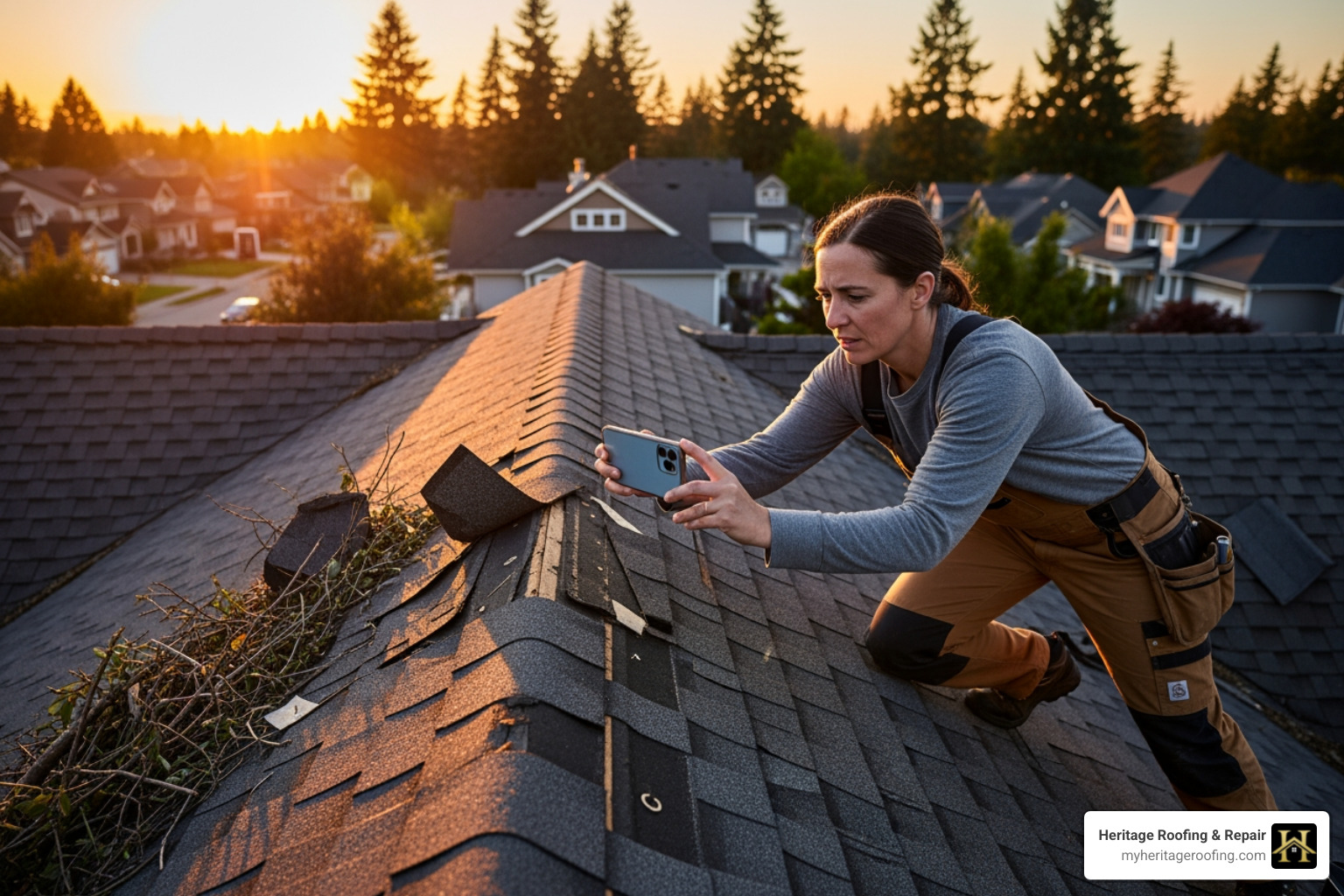
- Take clear photos and videos: Capture all damage from multiple angles, including wide shots and close-ups of both the exterior and interior.
- Create a written inventory: List all damaged personal property with descriptions, estimated age, and value. Include receipts or serial numbers if possible.
- Note date and time: Keep a log of when you took photos and first found the damage to establish a timeline.
- Gather crucial documents: Keep your insurance policy number, repair estimates, and receipts for temporary repairs. Record all communications with your insurer.
For a detailed inspection process, see our roof inspection checklist. The more evidence you have, the smoother your claim will be.
Common Types of Storm Damage to Look For
Storms in Arkansas can bring various damaging weather. Here’s what to look for:
- Roof damage: Look for missing, cracked, or curled shingles, hail dents, and wind-lifted shingles. Water stains on interior ceilings are a clear sign of a leak. Learn more about wind damage to your roof.
- Siding and gutter damage: High winds can tear or dent siding, while hail can leave cracks. Gutters can become detached or clogged, leading to drainage issues.
- Broken windows: Wind or flying debris can shatter windows, compromising your home’s security and allowing rain to enter.
- Foundation cracks: Severe flooding can cause soil erosion around your foundation, leading to new or worsening cracks.
- Interior water stains: Water can enter through damaged windows or compromised flashing, causing stains, bubbling paint, or warped flooring.
Step 2: Navigating Insurance and Emergency Repairs
After ensuring safety and documenting damage, the next step is to prevent further issues and start the insurance process.
Filing Your Homeowner’s Insurance Claim
Dealing with insurance can feel overwhelming, but it’s a crucial step in your home storm repair journey.

- Contact your insurer promptly: Report the damage as soon as it’s safe to do so. Delays can sometimes complicate your claim. Provide them with your claim number and all the documentation you’ve gathered.
- Review your policy for coverage details: Most homeowner’s insurance policies cover storm damage from hail, wind, fire, and snow. However, understand the specifics of your policy, including your deductible and any limitations.
- Understand flood insurance exceptions: A critical distinction: standard homeowner’s insurance policies typically do not cover flood damage. Flood insurance often requires a separate policy, usually through the National Flood Insurance Program (NFIP). If your damage is flood-related, ensure you’ve contacted the correct provider.
- Work with your insurance adjuster for accurate assessment: An adjuster will be assigned to inspect your property. Be present during this inspection, share your documentation (photos, videos, inventory), and point out all areas of concern. Keep a record of their name, contact information, and any discussions you have.
For more, see our homeowners insurance roof damage claim guide. Your policy is a contract, and understanding its terms is key to a successful claim.
Emergency Repairs: What to Do Now
While you wait for your insurance adjuster and professional contractors, making temporary repairs can prevent minor damage from becoming catastrophic. These are crucial steps to mitigate further loss and protect your property.
- Emergency tarping of roofs: If your roof has missing shingles, holes, or significant leaks, emergency tarping is essential. We can safely secure a heavy-duty tarp over the damaged area to prevent rain from entering your home, protecting your interior and belongings. This is a temporary measure, but it’s incredibly effective in preventing mold growth and further water damage.
- Boarding up broken windows: Shattered or severely cracked windows should be boarded up with plywood. This protects your home from the elements, secures it against intruders, and prevents additional debris from entering.
- Removing debris: Safely clear fallen branches, leaves, and other debris from your roof, gutters, and around your home. Be cautious of sharp objects and wear protective gear. Heavy or dangerous debris, especially large tree limbs, should be handled by professionals.
- Preventing mold growth: If water has entered your home, immediately begin drying out wet areas. Use towels, mops, and fans to circulate air. Removing wet carpeting, drywall, or insulation promptly is crucial to inhibit mold and mildew, which can begin to grow within 24-48 hours.
When in doubt, call for emergency roof repair. For major issues, always rely on professionals.
Here’s a quick guide to help you decide what you can tackle and what needs expert attention:
| Task | Homeowner (DIY) | Professional Contractor (P) |
|---|---|---|
| Immediate Safety Check | Gas leaks, electrical hazards, structural integrity | P (for assessment and repair) |
| Documenting Damage | Photos, videos, inventory | P (may assist with documentation for claims) |
| Minor Debris Removal | Small branches, scattered leaves | P (large trees, hazardous debris, roof clearing) |
| Catching Leaks | Buckets, towels | P (for temporary tarping and permanent repairs) |
| Temporary Window Board-Up | Basic plywood installation | P (for secure, weather-tight boarding) |
| Roof Tarping | Small, accessible areas (with extreme caution) | P (recommended for safety and effectiveness) |
| Electrical System Issues | Turning off main breaker (if safe) | P (licensed electrician only) |
| Gas Line Repair | Evacuate, call utility company | P (licensed plumber/gas technician only) |
| Structural Damage Assessment | Initial visual inspection | P (structural engineer, experienced contractor) |
| Water Extraction & Drying | Toweling, fans (for minor spills) | P (industrial dehumidifiers, water damage specialists) |
| Mold Remediation | Minor surface mold (small areas) | P (certified mold remediator for widespread growth) |
| Major Roof Repairs | Avoid | P (licensed roofing contractor) |
| Siding & Gutter Repair/Replacement | Minor reattachment of loose pieces | P (experienced siding/gutter specialists) |
Choosing a Trusted Storm Damage Contractor
After a storm, disreputable “storm chasers” often appear, preying on vulnerable homeowners. We strongly advise you to proceed with caution. Choosing the right contractor is paramount for quality home storm repair and a stress-free experience.
- Verify contractor licenses and insurance: Always ask for proof of current licensing and insurance (liability and worker’s compensation). A legitimate contractor will gladly provide these. This protects you from financial responsibility if an accident occurs on your property.
- Check local reviews and references: Look for contractors with a strong local presence and positive reviews on platforms like the Better Business Bureau. Ask for references from past storm repair clients and follow up on them.
- Request multiple written estimates: Obtain at least three detailed, written estimates that clearly outline the scope of work, materials, timeline, and cost. Be wary of contractors who pressure you for immediate decisions or ask for full payment upfront. Legitimate contractors will offer fair and reasonable estimates.
- Prioritize local expertise and established reputation: Local contractors, like us at Heritage Roofing & Repair, have a vested interest in the community. We understand local building codes, common storm patterns in Northwest Arkansas, and have a reputation to uphold with our neighbors. This Old House also advises vetting contractors by checking their credentials and references.
Step 3: Understanding the Costs of Home Storm Repair
The financial aspect of home storm repair can be daunting, but understanding the factors involved helps you budget and make informed decisions.
Key Factors Influencing Repair Costs
While the national average for storm damage repairs is about $12,444, with most homeowners spending between $2,677 and $22,211, these figures are just averages. Your specific costs will depend on several critical factors:
- Type and scope of damage (wind, hail, water): Hail damage might require shingle replacement, while severe wind damage could necessitate structural roof repairs. Water damage often involves interior repairs, mold remediation, and drying services. The larger the damaged area, the higher the cost.
- Replacement materials and labor rates: The quality and type of materials chosen (e.g., asphalt shingles vs. metal roofing) significantly impact costs. Labor rates in Northwest Arkansas for storm damage repairs can range from $50 to $150 per hour, depending on the trade and urgency. Emergency or after-hours repairs can increase labor costs by 20% to 50%.
- Location and permit fees: Different municipalities in Arkansas may have varying building codes and require specific permits for repairs, adding to the overall cost.
- Debris removal costs: After a severe storm, significant debris can accumulate. Professional debris removal can range from $500 to $5,000, depending on the volume and type of material.
For a detailed breakdown, see our roof repair estimate guide.
Repair vs. Replace: Making the Right Financial Decision
One of the most common dilemmas homeowners face after storm damage is whether to repair a component or replace it entirely. This decision impacts both immediate costs and long-term value.
- Consider age and condition of materials: If your roof is nearing the end of its typical lifespan (e.g., basic asphalt shingles typically last 15-20 years), a repair might only be a temporary fix. An older roof might not justify extensive repairs, especially if insurance payouts are lower due to depreciation.
- If over 50% of the roof is damaged, replacement is often more cost-effective: According to industry experts, if more than 50% of a component like your roof or siding is damaged, a full replacement often makes more financial sense. Repairing scattered damage can be piecemeal and lead to future issues.
- Evaluate warranty status and potential energy efficiency upgrades: If a damaged component is still under warranty, repairs might be covered. However, a full replacement can offer the opportunity to upgrade to more durable, energy-efficient materials that improve your home’s resilience and potentially lower utility bills over time.
See our ultimate guide to roof replacement costs for a comprehensive look at what’s involved.
Why Professional Home Storm Repair Matters
While some minor tasks can be handled by a homeowner, we always recommend professional assistance for most home storm repair projects.
- Professional repairs ensure structural integrity and safety: Our licensed and experienced contractors understand building codes and best practices. We ensure repairs meet safety standards, maintaining your home’s structural integrity, which is crucial after a storm. For example, roofing, electrical work, and structural repairs should always be handled by licensed professionals to prevent hazards and ensure code compliance. Improper DIY repairs can lead to serious safety risks, particularly for electrical systems or compromised structural elements.
- Improper repairs can lead to higher long-term costs and void warranties: A botched DIY repair might seem cheaper initially, but it can lead to more extensive and costly problems down the line, such as continued leaks, mold growth, or even structural failure. Additionally, some product warranties may be voided if repairs are not performed by certified professionals.
- Roofing, electrical, and structural work should always be handled by licensed professionals: These areas are complex and critical to your home’s safety and longevity. Attempting DIY repairs without proper expertise, tools, and safety equipment can be dangerous and result in substandard work. For instance, working on a damaged roof requires specialized safety gear and knowledge of roofing systems to prevent falls and ensure proper installation.
Reference: This Old House guide on roof repair strongly advises professional help for anything beyond the simplest roof issues, highlighting the risks and complexities involved.
Step 4: Future-Proofing Your Home Against Storms
After the repairs are complete, the work isn’t truly done. Building resilience into your home can significantly reduce the impact of future storms, saving you stress and money in the long run.
Preventative Measures to Minimize Future Damage
We believe in proactive protection. Here are steps you can take to make your home more resilient:
- Schedule routine roof inspections: We recommend at least an annual roof inspection, and certainly one after any major storm, even if no obvious damage is visible. Regular inspections can catch minor issues before they escalate.
- Maintain gutters and trim trees: Keep your gutters and downspouts clean and free of debris to ensure proper water drainage away from your foundation. Trim tree branches that are close to your home, as these can become projectiles or fall onto your roof during high winds.
- Upgrade to impact-resistant roofing materials: When it’s time for a roof replacement, consider impact-resistant shingles (often Class 4 rated) or metal roofing. These materials are designed to withstand severe hail and high winds better than standard options. Learn more about hail damage roof repair.
- Install hurricane straps and seal roof decks: Hurricane straps connect your roof trusses or rafters to your wall frames, creating a continuous load path that resists uplift from high winds. Sealing your roof deck with an ice and water shield underlayment provides a secondary moisture barrier, protecting your home even if shingles are lost.
Building Codes and Best Practices for a Stronger Home
Building codes exist to ensure safety, but “best practices” often go beyond minimum requirements to provide superior protection.
- Use high-wind rated materials and continuous load paths: When repairing or rebuilding, opt for materials rated for higher wind speeds. A “continuous load path” means all structural components, from the roof to the foundation, are securely connected. This prevents different parts of your home from separating during high winds.
- Install gable end bracing and follow ICC 600 standards: Gable end walls are often vulnerable to wind damage. Proper bracing and connections can significantly improve their resilience. The ICC 600 Standard provides prescriptive guidance for building and repairing homes in high-wind regions, going beyond basic code requirements.
- Adhere to local building codes and consider safe rooms: Always ensure your repairs comply with local building codes in Berryville, Fayetteville, Harrison, or wherever you are in Northwest Arkansas. For ultimate protection during severe weather, consider installing a residential safe room. These are specially designed and constructed shelters, either within your home or as a standalone structure, that provide near-absolute protection from tornadoes and hurricanes, including high winds and flying debris. They are life-saving investments in tornado-prone areas like ours.
Reference: FEMA disaster recovery resources offers extensive guidance on resilient construction.
Storm Damage in Arkansas: What You Need to Know
Arkansas experiences a unique set of weather challenges, making robust home storm repair and prevention crucial for our communities.
- Arkansas is prone to tornadoes, hail, and straight-line winds: We are unfortunately no strangers to severe weather. Our location in “Tornado Alley” means we regularly face the threat of tornadoes, which can cause catastrophic damage. Beyond tornadoes, strong thunderstorms frequently bring large hail and powerful straight-line winds, capable of significant damage to roofs, siding, and outbuildings.
- Common issues in Fayetteville and Northwest Arkansas include roof and siding damage: In areas like Fayetteville and across Northwest Arkansas, we frequently address roof damage from hail and wind, including missing shingles, granule loss, and punctures. Siding damage, such as cracks, dents, and detachment, is also very common. Our team in Fayetteville is well-versed in these local challenges.
- Local contractors understand regional building needs and materials: Working with a local contractor who has decades of experience in the region, like Heritage Roofing & Repair, means partnering with someone who understands the specific building challenges, common types of storm damage, and appropriate building materials for our climate. We know what works best to protect homes in Berryville, Harrison, and the surrounding areas.
Frequently Asked Questions about Home Storm Repair
How much roof damage requires a full replacement?
There’s no single magic number, but generally, a full roof replacement is recommended if:
- More than 30–50% of the roof is damaged: If a significant portion of your roof has sustained damage, patching it might be less cost-effective and provide less long-term protection than a complete replacement.
- The roof is nearing the end of its lifespan: If your roof is already old (e.g., asphalt shingles typically last 15-20 years) and suffers widespread damage, a replacement makes more sense than investing in repairs that only extend its life marginally.
- There are multiple leaks or structural issues: Persistent leaks in various areas or any compromise to the roof’s underlying structure indicate that a repair may not be sufficient.
A reputable contractor will provide a thorough inspection and help you compare the cost and benefits of repairs versus a full replacement, considering your roof’s age, condition, and the extent of the damage.
What should I do if my insurance claim is denied?
A denied claim can be disheartening, but it’s not always the final answer.
- Request a detailed written explanation: Your insurer is required to provide a specific reason for the denial.
- Review your policy carefully: Understand the clauses, exclusions, and limitations. Was the damage type covered? Did you meet all filing deadlines?
- Provide additional documentation: If you have more evidence (photos, contractor estimates, expert opinions) that supports your claim, submit it.
- Consider filing an appeal: You have the right to appeal the decision. Follow your insurer’s appeal process carefully.
- Consult a licensed public adjuster: A public adjuster works for you, not the insurance company, and can help steer complex claims, negotiate with your insurer, and ensure your interests are represented.
How can I avoid storm repair scams?
Unfortunately, dishonest individuals often surface after natural disasters. To protect yourself and ensure quality home storm repair:
- Work only with local, licensed, and insured contractors: Always verify their credentials. A legitimate contractor will happily provide proof.
- Avoid anyone who pressures you to sign immediately: High-pressure sales tactics are a major red flag. Take your time to research and get multiple estimates.
- Be wary of offers to waive your deductible: This is illegal in many states and can constitute insurance fraud.
- Never pay large cash payments upfront: A reputable contractor will have a reasonable payment schedule, often requiring a down payment followed by payments upon completion of agreed-upon milestones.
- Check references and reviews: Look for a track record of satisfied customers in your community.
Get Your Home and Life Back to Normal
Recovering from a storm is a multi-step process, but a structured approach dramatically shortens recovery time and reduces total repair costs. By prioritizing safety, carefully documenting damage, and working with trusted professionals, you can restore your home and regain your peace of mind. Heritage Roofing & Repair has served Berryville and Northwest Arkansas for over 50 years with reliable, high-quality craftsmanship. If your home has been impacted by a storm, our team is ready to provide a thorough inspection and guide you through the insurance and repair process from first call to final shingle.
Contact us for expert assistance with your storm damage roof repair.
Heritage Roofing & Repair
3458 Arkansas State Hwy 221, Berryville, AR 72616
Phone: (870) 654-1164