Why Flat Roof Preventative Maintenance Is Critical for Property Owners
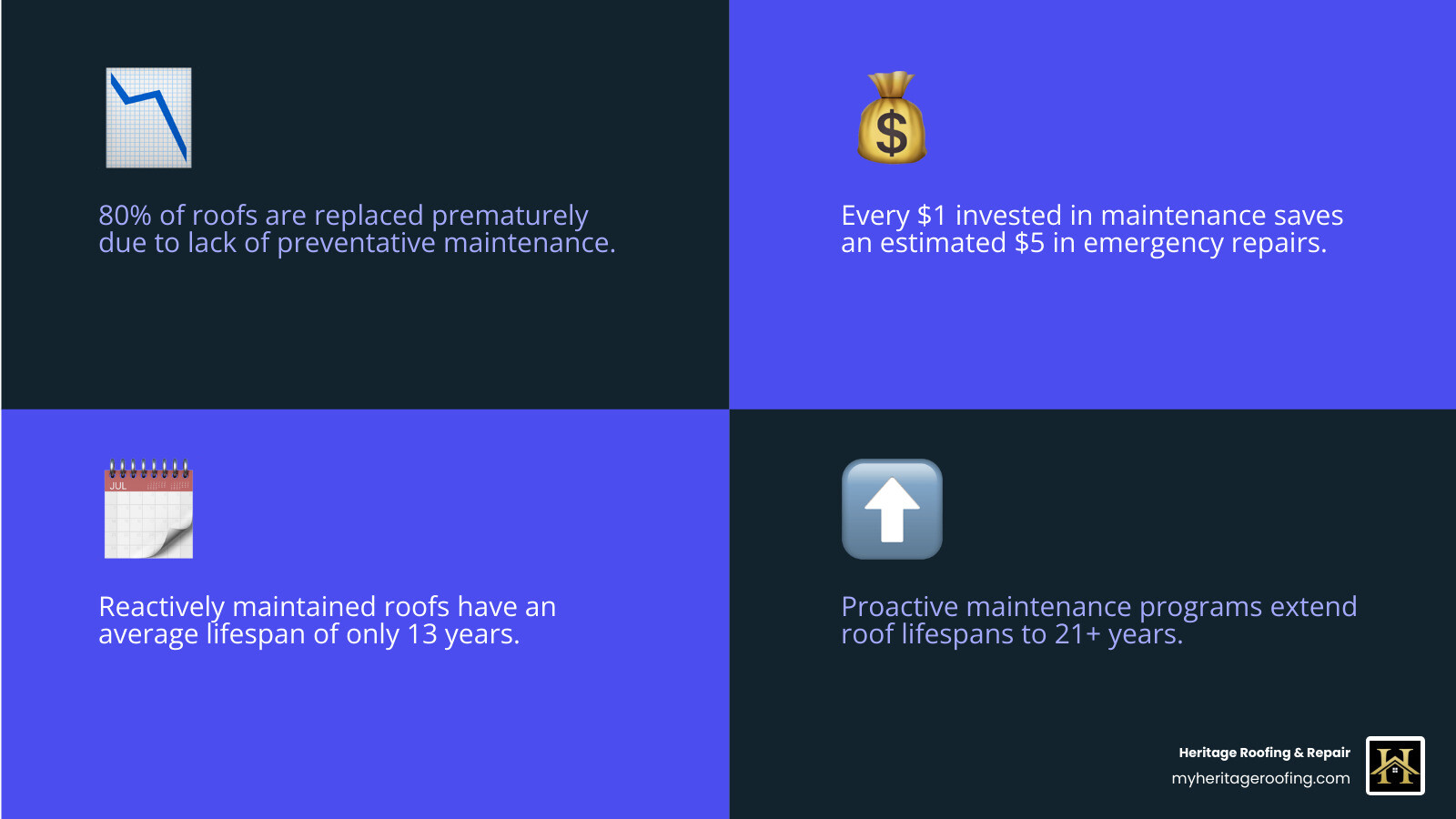
Flat roof preventative maintenance is a systematic plan of inspection, cleaning, and upkeep designed to prevent failures and maximize your roof’s lifespan. For Arkansas property owners, ensuring the integrity of your building with professional roofing services is the first step toward long-term security. This proactive approach is critical, as a staggering 80% of roofs are replaced prematurely due to a lack of routine maintenance.
Key maintenance tasks include:
- Bi-annual professional inspections (spring and fall)
- Regular drainage system cleaning to prevent ponding water
- Surface membrane checks for cracks, blisters, and punctures
- Flashing and sealant maintenance
- Debris and vegetation removal
- Post-storm damage assessments
Investing in maintenance delivers a significant return; for every $1 spent, property owners save an estimated $5 in emergency repairs. Without it, you risk water damage, voided warranties, business interruption, and premature replacement costs of $7-$30 per square foot.
I’m Rex Wisdom, owner of Heritage Roofing & Repair. For over 50 years, my family has helped Arkansas businesses implement effective flat roof preventative maintenance programs, turning potential liabilities into lasting assets.
Simple guide to flat roof preventative maintenance:
The High Cost of Neglect: Why Proactive Maintenance is a Smart Investment
A small, unnoticed crack in a flat roof membrane can escalate from a minor fix to a $15,000 emergency replacement as water damage compromises your building’s structure. This costly scenario is common but entirely preventable.
For every $1 invested in preventative maintenance, property owners save an estimated $5 in emergency repairs. This isn’t just a statistic—it’s a proven reality for smart property owners.
The numbers tell a stark story. Reactively maintained roofs have an average lifespan of only 13 years. In contrast, roofs under proactive maintenance programs can last 21 years or more. That’s an additional 8 to 10 years of service from your initial investment, simply by staying ahead of problems.
Emergency repairs and premature replacements cost between $7 to $30 per square foot, while regular maintenance is a fraction of that. But the true cost of neglect extends beyond repair bills. Business interruption can halt operations, damage inventory, and create liability issues. A sudden roof failure strikes at the worst possible moments, often during heavy storms when emergency services are stretched thin.
A well-maintained roof improves property value and protects everyone and everything beneath it. It transforms from a liability into an asset.
| Maintenance Approach | Average Lifespan (Years) | Cost Implication |
|---|---|---|
| Reactive | 13 | High emergency repair costs ($7-$30/sq ft), premature replacement, business interruption, voided warranties |
| Proactive | 21+ | Lower routine maintenance costs, extended roof life, preserved warranty, improved property value |
Warranty protection alone makes proactive maintenance worthwhile. Most manufacturers require documented proof of regular professional maintenance to honor claims. Failure to maintain your roof can result in complete claim denial, leaving you responsible for the entire replacement cost.
Investing in a comprehensive maintenance plan isn’t an expense—it’s strategic asset protection that delivers measurable returns and invaluable peace of mind.
Your Essential Flat Roof Preventative Maintenance Plan
A systematic flat roof preventative maintenance plan is like a health routine for your building. It provides predictability and control, changing your roof from a potential liability into a reliable asset that protects your investment year after year. A tiny crack spotted and sealed during a routine inspection saves you from a major leak, business disruption, and thousands in repairs.
A Systematic & Seasonal Inspection Schedule
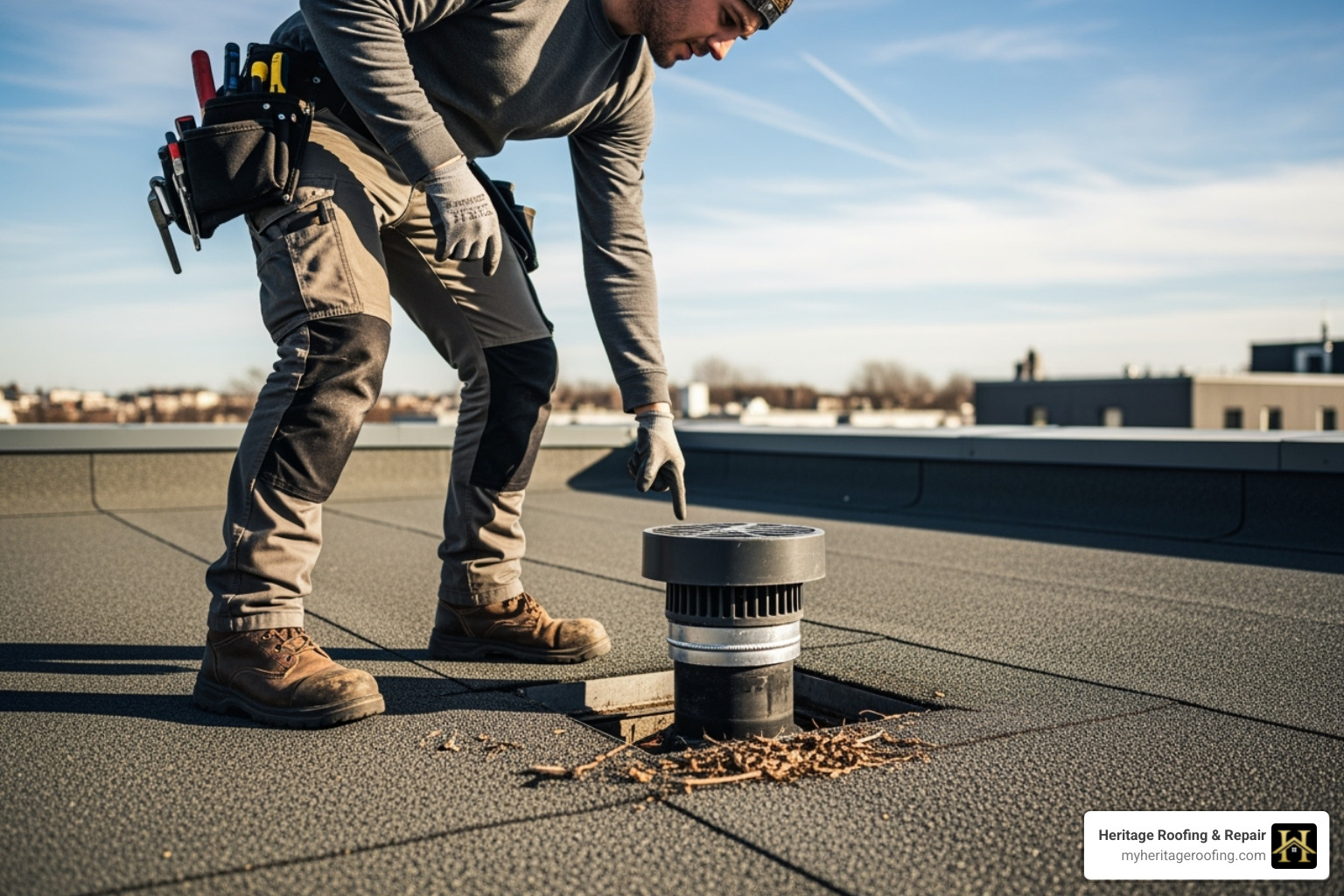
Regular, systematic inspections are the backbone of any successful maintenance program. Professional inspections should occur twice yearly (spring and fall), with additional checks after severe weather like hail or high winds. Maintaining a detailed maintenance log of all inspections, repairs, and cleaning is crucial. This documentation helps track your roof’s condition and is essential for preserving your roofing warranty.
Interior Warning Signs:
- Ceiling Stains: Yellow or brown marks are a red flag for moisture.
- Peeling Paint: Signals quiet moisture intrusion near ceiling edges.
- Musty Smells: Often points to hidden moisture.
- Mold or Damp Spots: Serious signs that demand immediate attention and can affect air quality.
Exterior Warning Signs:
- Ponding Water: Water lingering 48 hours after rain is your roof’s biggest enemy, breaking down the membrane and adding dangerous weight.
- Blisters or Bubbles: Trapped air or moisture that can burst and create leaks.
- Cracks, Tears, or Punctures: Obvious trouble spots that require immediate repair.
- Loose Seams: Separations where membrane sections join.
- Rusting: Indicates water pooling around metal components.
- Debris & Vegetation: Traps moisture and can cause significant damage.
Our detailed roof inspection checklist ensures nothing gets overlooked during these crucial checks.
Drainage System Upkeep: Your First Line of Defense
Unlike sloped roofs, flat roofs depend entirely on their drainage systems. When this system fails, the consequences are severe. Ponding water is the single greatest threat, accelerating membrane deterioration and adding enormous weight loads.
Drains, scuppers, gutters, and downspouts must remain clear of leaves and debris to prevent water backup. Even the roof’s slight slope is crucial; consistent ponding may indicate a slope or structural issue requiring professional attention. For DIY tips, the Flat Roof Maintenance Checklist offers helpful guidance.
Surface and Membrane Care: Spotting Trouble Early
Your roof’s membrane is the primary waterproof barrier. Understanding your membrane type—whether EPDM, TPO, PVC, or Modified Bitumen—helps identify specific vulnerabilities.
Common issues include:
- Blistering: Trapped air or moisture that can burst, creating entry points for water.
- Cracking: Caused by UV exposure and temperature changes, creating immediate leak paths.
- Ridging: Long, narrow cracks in bituminous roofs, often along insulation joints.
Early detection and repair are key. For owners of rubber roofs, our EPDM roof installation complete guide offers specific maintenance details.
A Seasonal Guide to Maintenance Tasks
- Spring: After winter’s freeze-thaw cycles, inspect for splits and cracks. Clear all drains, scuppers, and gutters of winter debris. Check for new moss or algae growth and examine seams and flashings for separation.
- Summer: Intense heat and UV radiation can cause cracking and blistering. Check for UV damage and ensure HVAC units aren’t leaking condensation onto the roof. Verify that any reflective coatings are intact to reduce heat absorption.
- Fall: Prepare for winter by clearing leaves and branches from the roof and drainage systems to prevent clogs. Trim overhanging trees and perform a final thorough inspection before cold weather arrives.
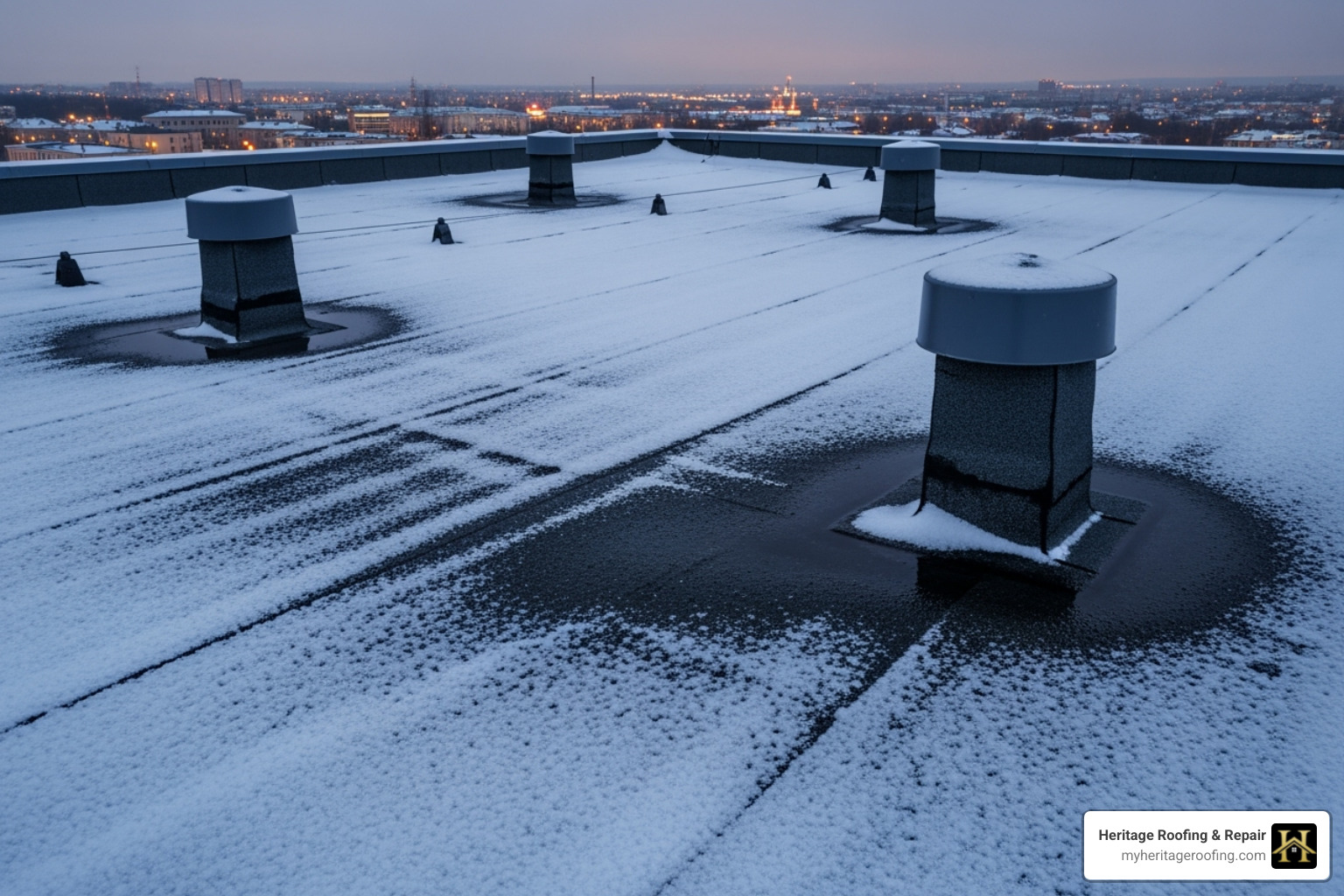
- Winter: Carefully monitor snow accumulation, as heavy loads can exceed your roof’s capacity (over 12 inches can be dangerous). Ensure drains are not blocked by ice dams, which can cause water to back up under the membrane.
Timing is Everything: Seasonal Maintenance & Inspection Frequency
Effective flat roof preventative maintenance hinges on consistency. Maintenance needs change with the seasons, as different weather conditions present unique challenges. A structured schedule ensures your roof is prepared for anything the Arkansas climate throws at it, from scorching summers to icy winters.
How Often Should You Inspect Your Flat Roof?
A flat roof requires professional inspection at least twice a year, ideally in the spring and fall. These check-ups allow a professional to identify and address issues caused by seasonal stress before they escalate.
Property owners should also perform visual checks after any severe weather event, such as heavy rain, hail, or high winds. This immediate assessment can catch storm damage early.
Maintaining a detailed maintenance log is crucial. This record should document all inspections, repairs, and cleaning activities. This documentation helps track your roof’s condition and is essential for maintaining your roofing warranty, as many manufacturers require it for claims.
For more details on what to look for, our roof inspection checklist offers a comprehensive guide.
A Seasonal Guide to Flat Roof Preventative Maintenance
Spring: After winter’s freeze-thaw cycles, inspect for splits and cracks. Clear all drains, scuppers, and gutters of winter debris. Check for new moss or algae growth and examine seams and flashings for separation.
Summer: Intense heat and UV radiation can cause cracking and blistering. Check for UV damage and ensure HVAC units aren’t leaking condensation onto the roof. Verify that any reflective coatings are intact to reduce heat absorption.
Fall: Prepare for winter by clearing leaves and branches from the roof and drainage systems to prevent clogs. Trim overhanging trees and perform a final thorough inspection before cold weather arrives.
Winter: Carefully monitor snow accumulation, as heavy loads can exceed your roof’s capacity (over 12 inches can be dangerous). Ensure drains are not blocked by ice dams, which can cause water to back up under the membrane.
Extending Your Roof’s Lifespan: Advanced Strategies & Warranty Protection
Beyond basic maintenance, advanced strategies can significantly extend your flat roof’s lifespan and protect your warranty. These are strategic investments that add years to your roof’s life and value to your property.
The Role of Roof Coatings and Insulation
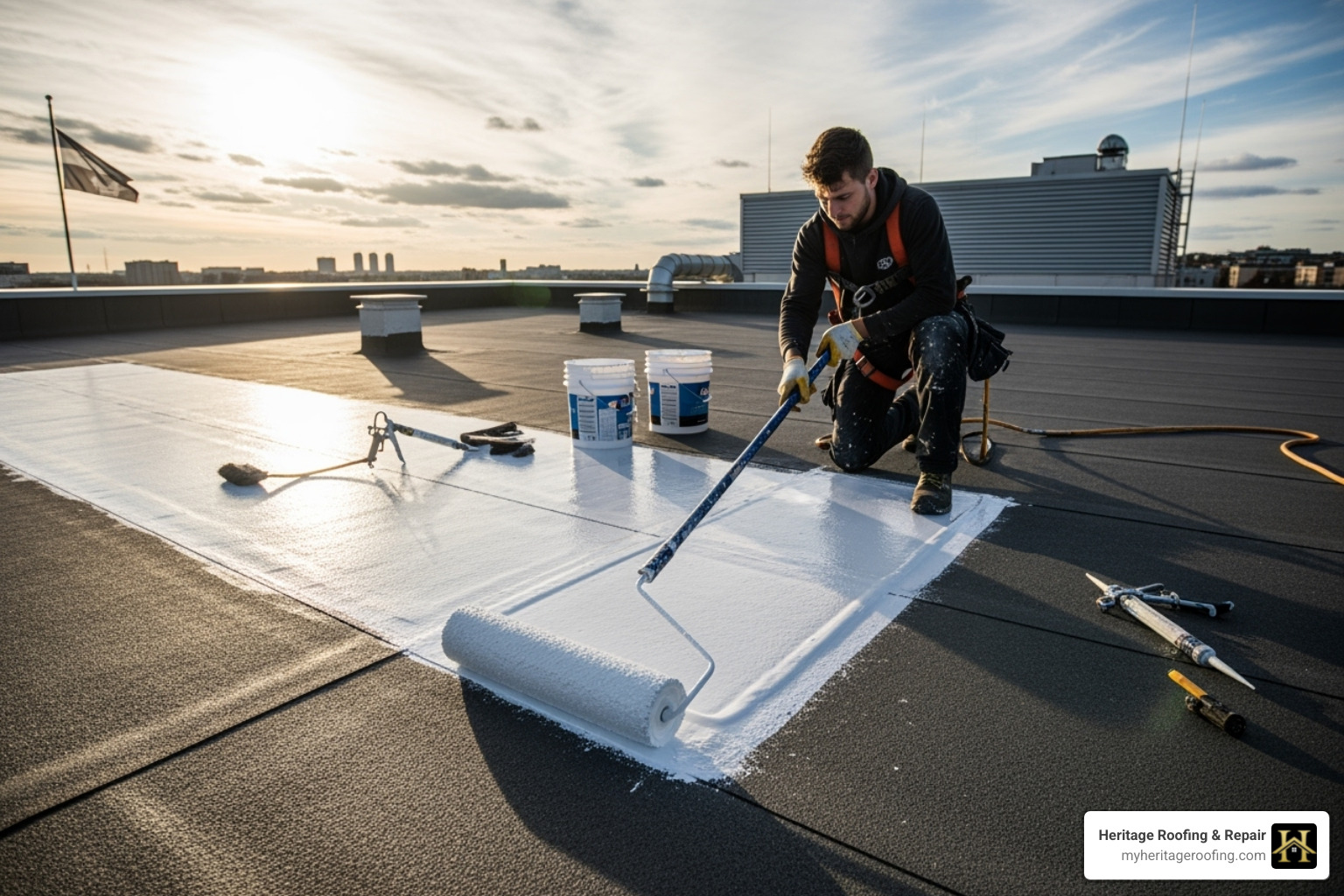
Reflective roof coatings act like sunscreen for your building, creating a seamless, UV-resistant barrier. These coatings reflect up to 90% of the sun’s rays, reducing roof surface temperatures by 50-70°F. This translates into cooling cost reductions of 15-30% and protects the membrane from thermal stress, potentially extending its life by 10-15 years.
Proper insulation works with coatings to prevent condensation. Trapped moisture from condensation can lead to mold, membrane deterioration, and hidden structural damage. Together, insulation and reflective coatings create a thermal barrier system that reduces stress on the membrane and improves energy efficiency. Our silicone roof coating applications are a great example of this protective technology.
How Proper Maintenance Protects Your Roofing Warranty
While a warranty provides a safety net, its validity often depends on you. Manufacturers typically require documented proof of professional maintenance to honor a claim. Your maintenance log—complete with dates, photos, and professional assessments—serves as this crucial evidence. This record proves that any failure is due to a product defect rather than neglect, which is your best defense against a costly claim denial. Partnering with a qualified contractor who understands specific warranty requirements is the most effective way to ensure your documentation is complete and your investment remains protected.
At Heritage Roofing & Repair, we help clients maintain comprehensive records that satisfy warranty requirements. Explore our roofing warranty services to find the peace of mind that comes with professional partnerships.
When to Call the Professionals in Berryville, AR
While some basic tasks are DIY-friendly, many aspects of flat roof preventative maintenance require professional expertise. Knowing when to call for help protects both your roof and your personal safety.
Safety should always be your top priority. Accessing a roof without proper safety equipment like harnesses and non-slip footwear is dangerous, especially in wet or windy conditions. If you’re uncomfortable with heights, call a professional.
Call for expert intervention for these issues:
- Persistent Leaks: If you have a recurring leak or can’t find the source, DIY fixes can make it worse. A professional uses tools like infrared cameras to find hidden moisture.
- Complex Inspections: An untrained eye can miss early signs of failure. Professionals spot subtle issues that can become major problems.
- Extensive Damage: Large cracks, widespread blistering, or significant ponding require a certified contractor with the right tools and materials.
- Warranty Compliance: Many warranties require professional maintenance to remain valid. A certified roofer ensures all work meets manufacturer specifications.
Finding a Trusted Local Roofing Expert
For significant repairs or comprehensive inspections, a certified professional is essential. For property owners in the Berryville area, a local roofer understands the challenges of the Arkansas climate. At Heritage Roofing & Repair, we’ve spent over 50 years helping local businesses steer everything from scorching summers to ice storms. When you need reliable commercial roofing solutions, our team brings the right tools, expertise, and safety equipment to every job.
We’re here when you need us most.
Heritage Roofing & Repair
3458 Arkansas State Hwy 221, Berryville, AR 72616
(870) 654-1164
Frequently Asked Questions about Flat Roof Maintenance
Over 50 years, we’ve answered countless questions about flat roof preventative maintenance. Here are the most common ones.
What are the most common problems with flat roofs?
The single biggest enemy is ponding water from clogged drains or poor slope, which degrades the membrane and adds dangerous weight. Other common issues are membrane damage (punctures, blisters, tears) and flashing failures around vents, HVAC units, and skylights. All of these are preventable with regular maintenance.
Can I perform flat roof maintenance myself?
Yes, you can handle basic tasks like clearing loose debris and performing visual inspections from the ground. However, we strongly recommend leaving complex tasks to professionals. Walking on the roof, ladder work, and applying sealants pose safety risks and require training. Improper DIY repairs can void your warranty and cause bigger problems, so it’s best to call a professional when in doubt.
How much does a flat roof maintenance plan cost?
A flat roof preventative maintenance plan typically costs between $4 and $13 per square foot annually, depending on the roof’s size, condition, and membrane type. This is a smart investment when you consider that emergency repairs or a full replacement can cost $7 to $30 per square foot. For every $1 you spend on preventative maintenance, you save an estimated $5 in emergency repairs.
Protect Your Investment with a Proactive Plan
Your flat roof is a critical asset that protects your entire building. Implementing a consistent flat roof preventative maintenance program is the most effective way to safeguard your commercial property. A proactive approach extends your roof’s functional life, prevents costly emergency repairs, and ensures you don’t join the majority of owners who replace their roofs prematurely due to neglect.
A healthy roof means a secure building, uninterrupted business operations, and a protected bottom line. It preserves property value, maintains warranty coverage, and ensures the safety of everyone inside. The peace of mind that comes with a well-maintained roof is invaluable.
With over 50 years of trusted experience, Heritage Roofing & Repair is the go-to expert for businesses in Berryville, Fayetteville, Harrison, and across Northwest Arkansas. Our commitment to dependable, affordable, and quality craftsmanship means you get the expertise you need without breaking the bank.
If you’re ready to protect your property with a professional maintenance plan, explore our comprehensive commercial roofing services and contact us today for a thorough evaluation. Your roof—and your peace of mind—will thank you.