Why Understanding Roof Insurance Claims Matters for Arkansas Homeowners
After a severe storm damages your roof, the last thing you need is a stressful, confusing insurance process. Yet, with severe weather events causing billions in insured losses annually, understanding how do roof insurance claims work is critical. Navigating deductibles, depreciation, and adjusters can feel overwhelming, but for homeowners in Arkansas, having a trusted guide through the roof insurance claim process is the key to a successful outcome. This guide provides the A-to-Z knowledge you need to get your roof covered and your home protected.
Most homeowners don’t realize their policy’s limitations until it’s too late. Terms like “Actual Cash Value” and “Replacement Cost Value” directly impact your payout by thousands of dollars. A claim denial often stems not from a lack of damage, but from missed deadlines, poor documentation, or policy exclusions. This is why having a knowledgeable advocate makes all the difference.
For over 50 years, Heritage Roofing & Repair has helped Northwest Arkansas homeowners successfully steer insurance claims, ensuring they receive fair settlements and quality repairs. We turn a complicated process into a straightforward one.
Understanding Your Policy: What’s Covered and What’s Not?
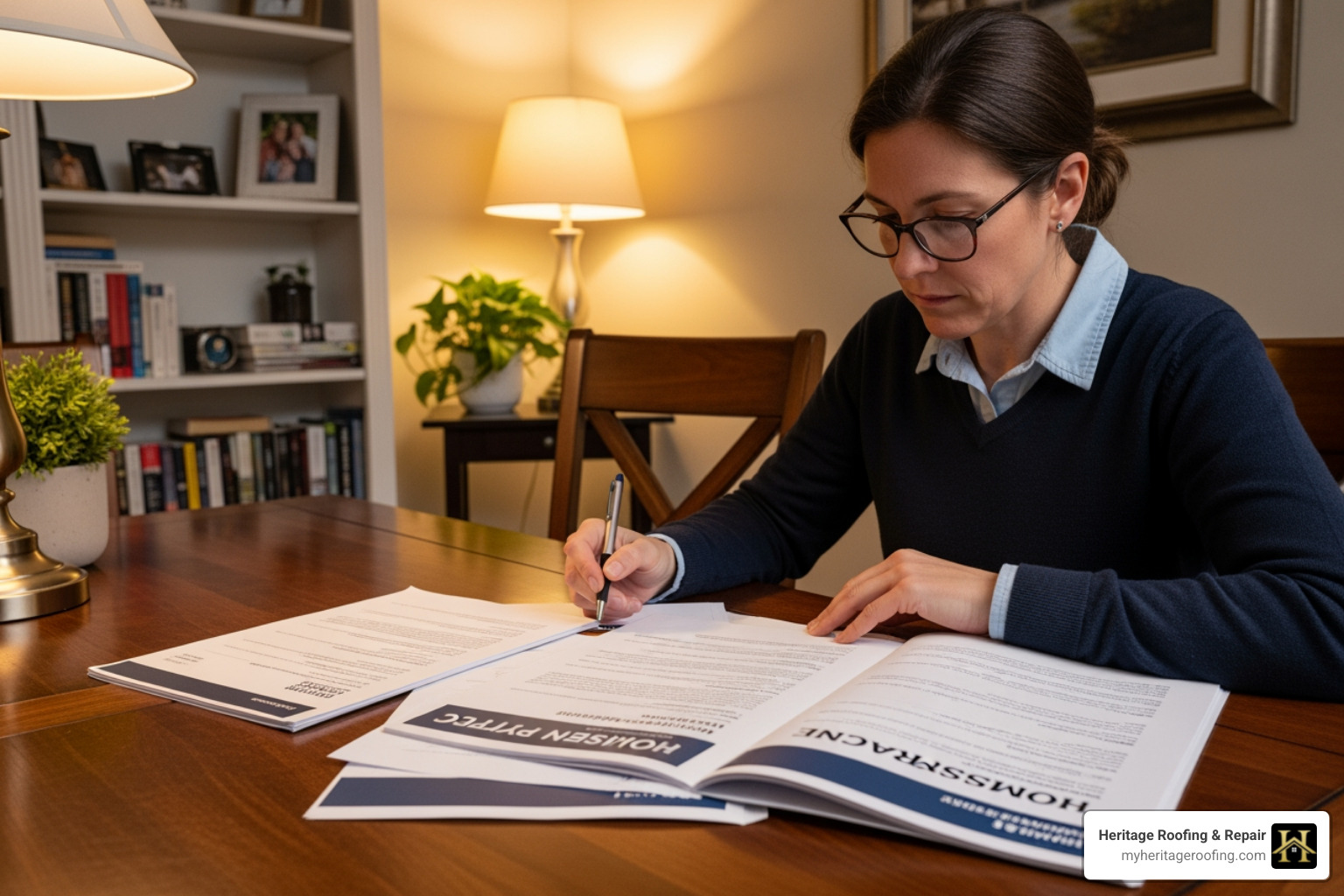
Before you wonder how do roof insurance claims work, you must understand what your homeowners insurance policy covers. Reviewing your policy annually—not just after a storm—is the most critical step to ensure you are prepared.
Covered Perils vs. Common Exclusions
Homeowners insurance is designed to cover damage that is sudden and accidental. Understanding what is and isn’t covered can save you from an automatic denial.
Typically Covered:
- Wind & Hail: Damage from high winds tearing off shingles or hail bruising your roof’s surface is almost always covered.
- Fire: Standard policies cover fire damage, whether it originates inside or outside your home.
- Falling Objects: Damage from trees or large branches is generally covered, including the cost of debris removal.
- Vandalism: Malicious or intentional damage to your roof is typically included.
Commonly Excluded:
- Normal Wear and Tear: Your roof has a finite lifespan. Gradual deterioration like curling or fading shingles is not covered.
- Neglect or Poor Maintenance: Insurers will deny claims if damage results from uncleaned gutters, unchecked moss growth, or ignored leaks. This is why routine professional roof inspections are vital.
- Faulty Workmanship: Damage from a previous contractor’s poor installation is their responsibility, not your insurer’s.
- Floods & Earthquakes: These events require separate, specialized insurance policies.
- Manufacturer Defects: Premature material failure is covered by the manufacturer’s warranty, not your homeowner’s policy.
Open Peril vs. Named Peril Policies
The type of policy you have determines what’s covered.
- An open peril policy (also called “all-risk”) covers all causes of loss except those specifically listed as exclusions. With this policy, the burden is on the insurance company to prove an exclusion applies.
- A named peril policy only covers the specific events, or “perils,” listed in the document. With this policy, the burden is on you to prove the damage was caused by a listed peril.
Most standard HO-3 policies provide open peril coverage for the dwelling structure, offering broader protection.
The Impact of Your Roof’s Age and Maintenance
An older roof is seen as a higher risk by insurers. For roofs over 10-15 years old, depreciation is applied more heavily, reducing your payout. Some insurers may even offer limited coverage or deny claims for roofs over 20 years old, arguing the damage is due to age rather than a specific storm.
Maintenance records are your best defense. Documenting inspections, repairs, and cleaning demonstrates that you have been a diligent homeowner and that the damage is new, strengthening your claim against arguments of neglect.
The Financials of a Roof Claim: ACV, RCV, and Deductibles
Understanding the financial terms in your policy is essential to avoiding an unexpected, costly surprise. The difference between policy types can mean thousands of dollars out of your pocket.

Replacement Cost Value (RCV) vs. Actual Cash Value (ACV): What’s the Difference?
This is the most critical financial distinction in your policy. Replacement Cost Value (RCV) pays the full cost to replace your damaged roof with new materials of similar quality, without deducting for depreciation. Actual Cash Value (ACV) pays only for the depreciated value of your roof, meaning you cover the difference.
| Feature | Replacement Cost Value (RCV) Policy | Actual Cash Value (ACV) Policy |
|---|---|---|
| Definition | Pays to replace your roof with new materials, without deducting for depreciation. | Pays to replace your roof, minus depreciation for age and wear. |
| Payout | Two payments: an initial check for the ACV, and a final check for the recoverable depreciation after work is complete. | A single payment for the depreciated value of your roof. |
| Out-of-Pocket | Your deductible. | Your deductible plus the depreciated amount. |
| Best For | Homeowners who want full coverage without significant out-of-pocket costs. | Homeowners seeking lower premiums who can afford to pay more for a replacement. |
For example, on a $15,000 roof replacement with $7,000 in depreciation and a $1,000 deductible, an RCV policyholder pays only the $1,000 deductible. An ACV policyholder would pay their $1,000 deductible plus the $7,000 in depreciation, for a total of $8,000 out-of-pocket.
How Does a Deductible Work in a Roof Insurance Claim?
Your deductible is the amount you must pay before your insurance coverage begins. It is typically a fixed amount (e.g., $1,000) or a percentage of your home’s insured value (e.g., 1%). If your approved claim is $10,000 and your deductible is $1,000, your insurer pays $9,000.
It is illegal for a contractor to waive, cover, or absorb your deductible. This practice constitutes insurance fraud and puts you at serious legal risk. A reputable contractor will never offer this.
Understanding Ordinance and Law Coverage
Building codes change over time. Your standard policy covers replacing what you had, but it does not cover the extra costs to bring your roof up to current codes. Ordinance and Law Coverage is an optional add-on that pays for these mandatory, and often expensive, upgrades. Without it, these costs come directly out of your pocket. We strongly recommend ensuring your policy includes this vital protection.
How Do Roof Insurance Claims Work? A 5-Step Guide
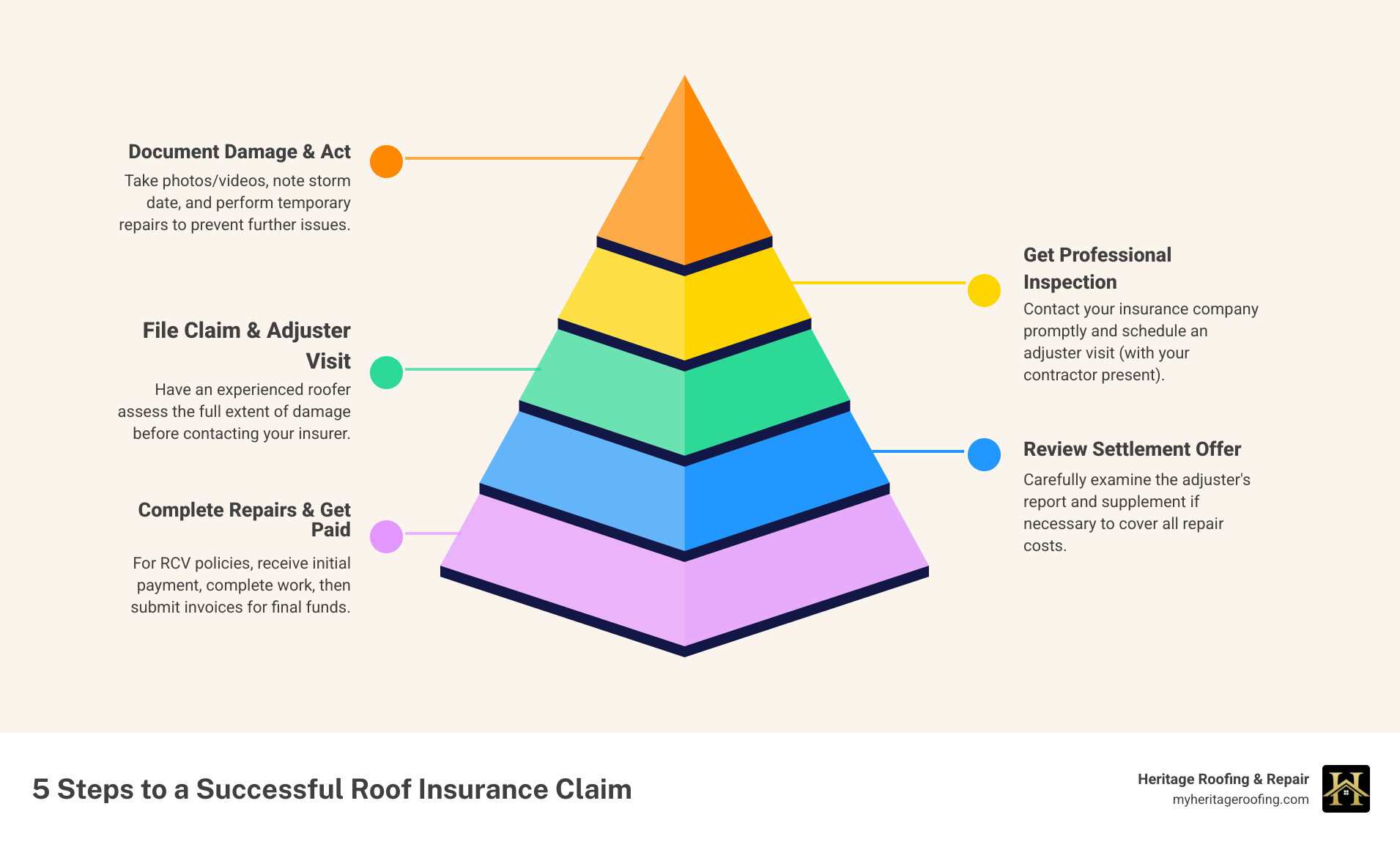
Navigating a roof insurance claim is a manageable process when broken down into clear steps. With an experienced partner, you can move through it with confidence. Here is our 5-step guide based on five decades of helping Northwest Arkansas homeowners with successful claims.
Step 1: Immediate Actions & Damage Documentation
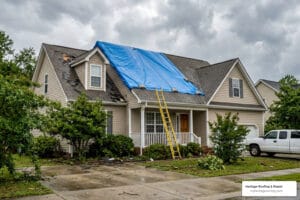
After a storm, your first priority is safety. Once the area is secure, your next job is to prevent further damage by making temporary repairs, like tarping exposed areas. Thorough documentation is your most powerful tool.
- Take photos and videos of all visible damage from multiple angles—close-ups and wide shots.
- Photograph collateral damage to gutters, siding, and AC units as corroborating evidence.
- Note the date and time of the storm and save local weather reports.
- Keep all receipts for temporary repair materials.
Step 2: Get a Professional Roof Inspection
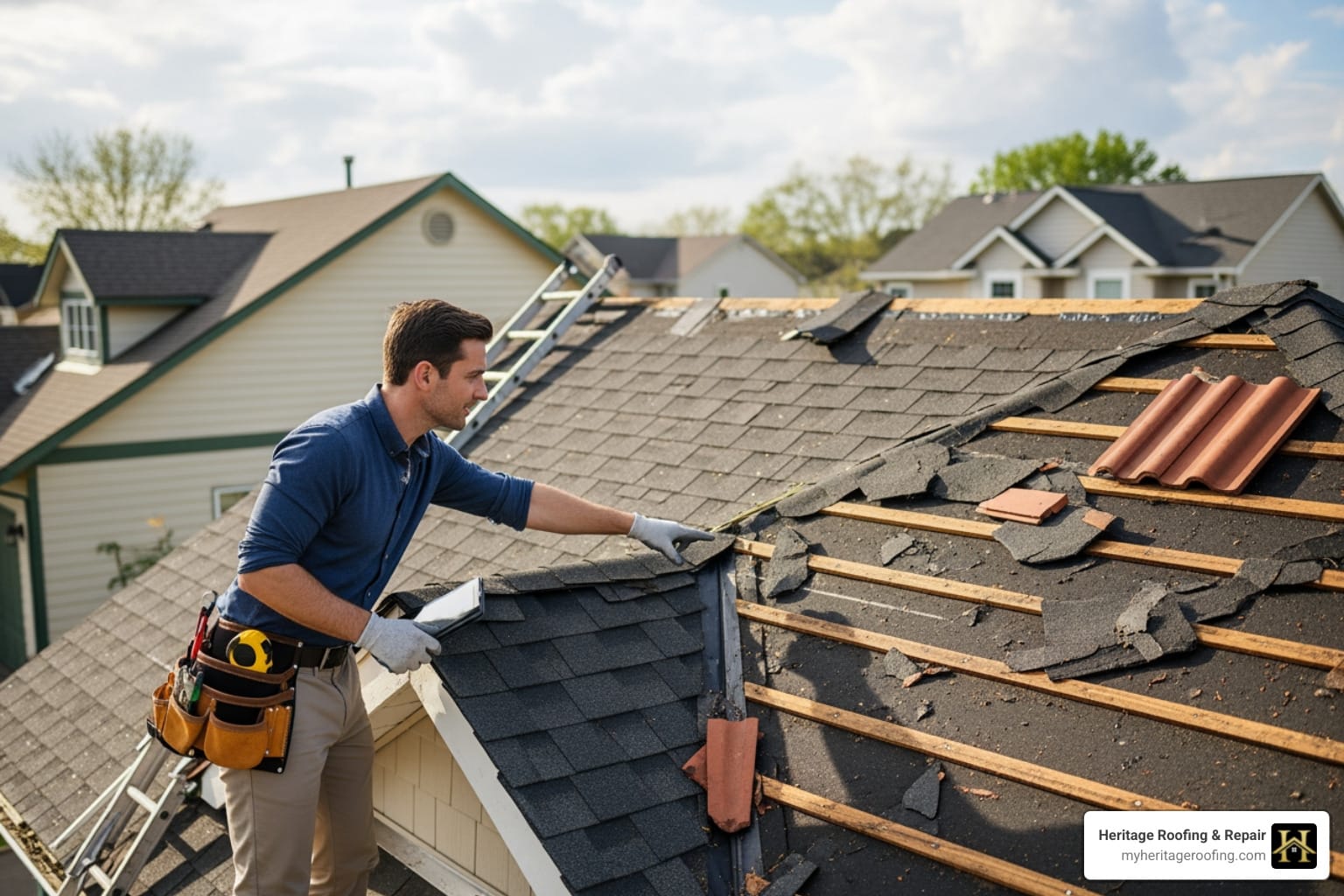
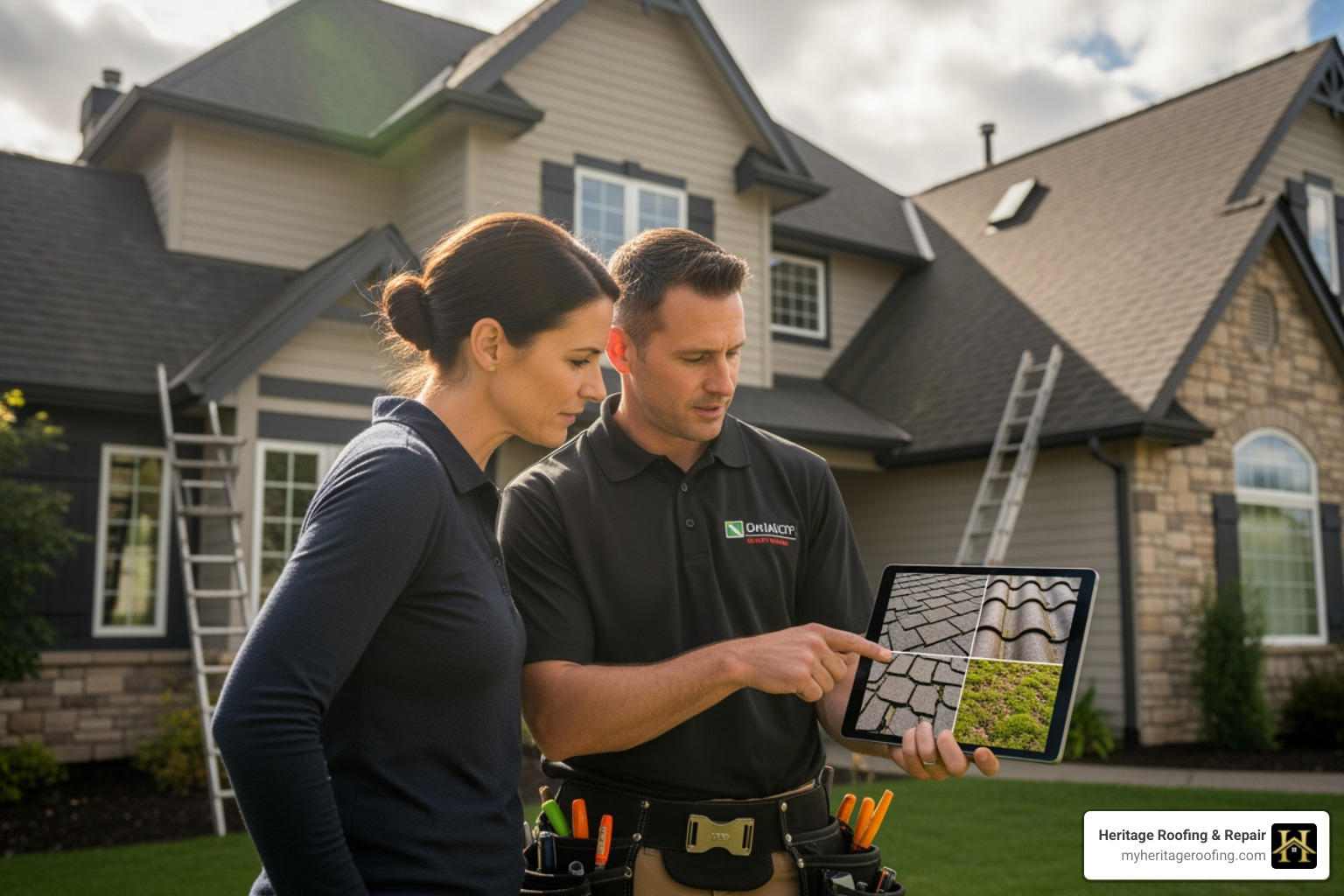
Before contacting your insurer, have an experienced roofing contractor perform a thorough inspection. An insurance adjuster works for the insurance company; a roofer works for you. We identify damage that adjusters often miss, such as hail bruising or cracked sealant strips that aren’t visible from the ground. A detailed report from a professional gives you leverage and a clear understanding of the necessary repairs before you ever speak with the adjuster.
Step 3: Filing the Claim & The Adjuster’s Visit
With your professional assessment in hand, contact your insurance provider to file a claim. You will receive a claim number—keep it for all future communication. The insurer will then schedule an adjuster to visit your property.
Crucial advice: Have your contractor present during the adjuster’s visit. This is the single most important decision you can make. Your contractor can point out all identified damage, speak the adjuster’s language, and ensure the assessment is accurate and complete. This prevents items from being overlooked and can add thousands of dollars to your settlement.
Step 4: Reviewing the Settlement & Scope of Work
After the visit, you will receive a settlement offer and a scope of work. Review it carefully. Initial insurance estimates, often created with software like Xactimate, frequently undervalue the true cost of repairs. They may use outdated pricing or omit necessary line items for materials, labor, and local code requirements.
This is where we step in to supplement the claim. We review the adjuster’s report line-by-line and submit a detailed supplement with justification for any missing or undervalued costs. This is a standard and expected part of the process. Never agree to a settlement until you are confident it covers the full cost of a proper repair.
Step 5: Getting Your Roof Replacement and Final Payment
Once the settlement is agreed upon, the work begins. The payment process depends on your policy.
- For RCV policies: You receive an initial check for the Actual Cash Value (ACV) minus your deductible. After we complete your Roof Replacement, you submit our final invoice to the insurer. They then release the remaining funds, known as recoverable depreciation.
- For ACV policies: You receive a single check for the depreciated value of your roof. You are responsible for paying the difference between that amount and the total replacement cost.
We manage this entire process, from the initial inspection to final payment, ensuring you receive every dollar you are entitled to under your policy.
Navigating Challenges: Denials, Scams, and Finding the Right Help
Even a well-documented claim can face challenges like denials or scams. Knowing how to respond and who to trust is key to protecting your home and finances.
What to do if your roof insurance claim is denied
A claim denial is not the final word. First, demand a written explanation for the denial. Common reasons include wear and tear, poor maintenance, or insufficient evidence. Consult with your roofing professional to assess the denial’s validity. If it seems unjustified, you can file an internal appeal with your insurer, providing additional evidence like a more detailed damage report. For complex cases, a public adjuster who works for you (not the insurer) can be hired to negotiate on your behalf. As a last resort, an attorney specializing in insurance law can advise on legal action.
The Role of a Roofing Contractor in Claims
When navigating how do roof insurance claims work, an experienced storm restoration contractor is your most valuable asset. We act as your expert advocate by:
- Documenting damage in the specific way insurers require.
- Meeting the adjuster on-site to ensure a complete and accurate assessment.
- Supplementing the claim to cover all necessary costs that initial estimates often miss.
Contractors with specialized training, such as GAF’s insurance restoration training, are equipped to manage the complexities of the claims process and secure the full coverage you deserve.
Avoiding Common Pitfalls and Roofing Scams
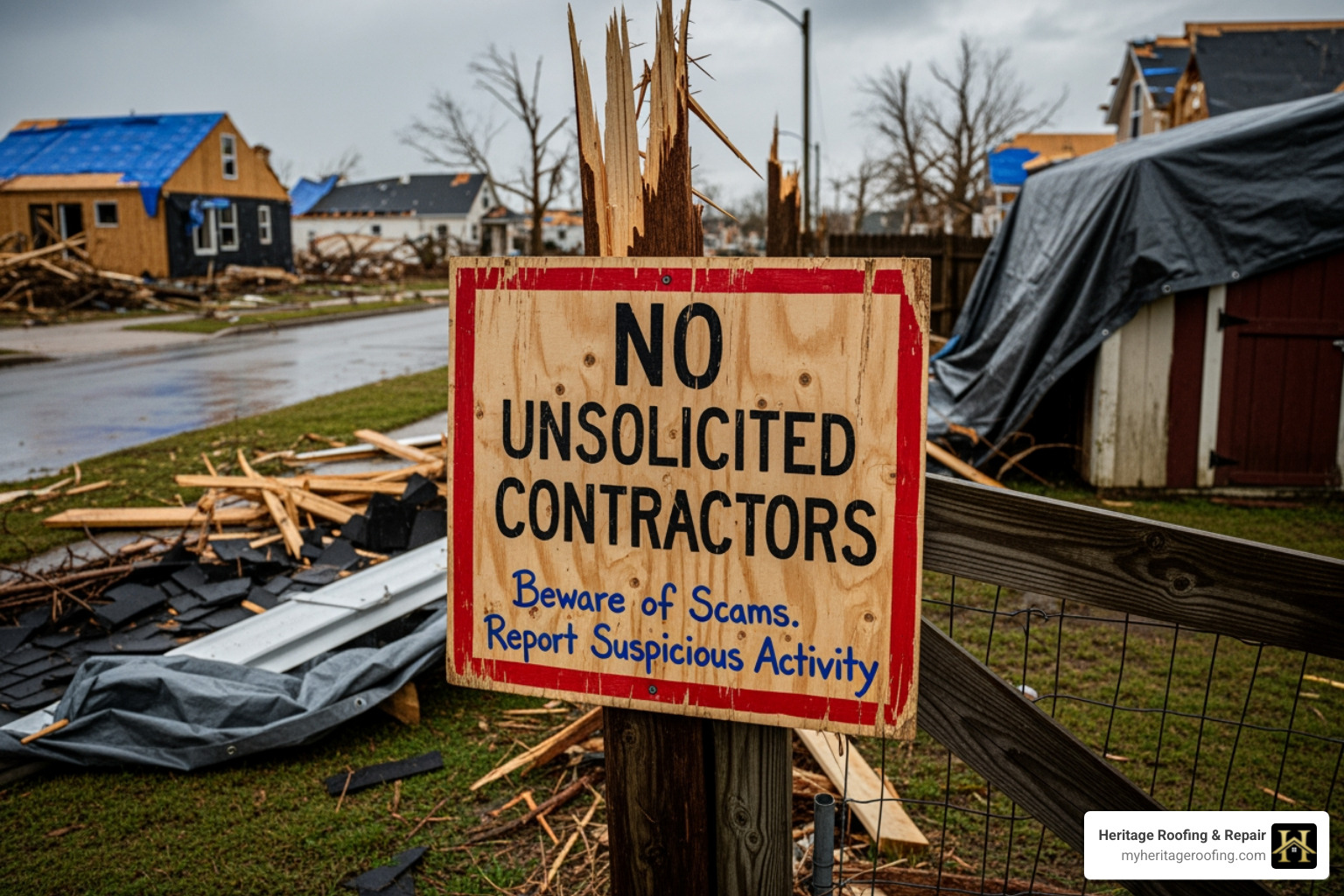
After a storm, be wary of “storm chasers”—out-of-state contractors who use high-pressure tactics and disappear after the job. Here are the red flags:
- Offering to “waive” or “cover” your deductible. This is insurance fraud.
- Demanding large upfront payments or pressuring you to sign a contract immediately.
- Lacking a local office, proper licensing, or proof of insurance.
Never sign a contract before your claim is approved and you understand the full scope of work.
Finding a Reputable Local Roofer in the Berryville Area
Choosing an established, local roofer ensures accountability and quality. A local company understands regional weather challenges, is familiar with local building codes, and has a reputation to uphold in the community. Always verify a contractor’s license and insurance, and check customer reviews and local references.
At Heritage Roofing & Repair, we have built our reputation on trust and quality for over 50 years. We are your local experts in storm damage and insurance claims.
Heritage Roofing & Repair 3458 Arkansas State Hwy 221, Berryville, AR 72616 (870) 654-1164
We also proudly serve homeowners looking for roofing companies in Harrison, Arkansas, providing the same expertise across Northwest Arkansas.
Frequently Asked Questions about Roof Insurance Claims
Here are direct answers to the most common questions we hear from Northwest Arkansas homeowners about how do roof insurance claims work.
Should I file a claim if the repair cost is close to my deductible?
It is generally not advisable. If the repair cost is only slightly more than your deductible (e.g., a $1,200 repair with a $1,000 deductible), the small payout of $200 may not be worth the potential impact on your insurance record. A good rule of thumb is to consider paying out-of-pocket for repairs that cost less than 125% of your deductible. This preserves your claims history for more significant events.
Will filing a roof claim raise my insurance premium?
It might. A single weather-related claim, especially from a widespread storm, is less likely to cause a rate hike. However, insurers’ data shows that multiple claims within a three-to-five-year period significantly increase your risk profile. This can lead to premium increases of 20-40% or even non-renewal of your policy. Many insurers also offer a “claim-free discount” that you would lose after filing.
How long does the roof insurance claim process take?
The entire process typically takes anywhere from 30 days to several months. After you file, an adjuster visit is usually scheduled within 7-14 days. You can expect a decision on your claim within 15-40 days of the inspection. Delays are common after major storms when adjusters are backlogged or if your claim requires supplements or appeals. For a smooth claim, expect a timeline of 6-8 weeks; for a complex one, it could be 3-4 months. Persistent, professional communication is the key to keeping the process moving.
Conclusion
Understanding how do roof insurance claims work transforms a daunting task into a manageable process. By knowing your policy, documenting damage thoroughly, and partnering with a trustworthy local professional, you can steer the system with confidence. An experienced roofer is more than an installer—they are your advocate, ensuring a fair settlement and a quality repair that restores your home’s integrity.
For over 50 years, Heritage Roofing & Repair has stood beside Arkansas homeowners, guiding them from the initial damage assessment to the final insurance payment. We’ve worked with every major insurer and helped countless families in Berryville, Harrison, and across Northwest Arkansas get the protection they deserve without the stress.
Our commitment to dependable, affordable, and quality craftsmanship provides more than a new roof—it provides peace of mind. Whether you’re dealing with recent storm damage or want to understand your policy better, we are here to help.
For a complete overview of the process, explore our Roof Insurance Claims Ultimate Guide, and don’t hesitate to reach out with questions.