Is It Wear and Tear or a Defective Roof?
A defective shingles insurance claim is filed when a roof fails prematurely due to manufacturing flaws, not normal aging. If your seven-year-old roof has shingles cracking across entire sections, or your gutters are full of granules without a recent storm, you may be dealing with a defect. Understanding your options is the first step toward protecting your home and your investment.
Unlike straightforward storm damage, proving a manufacturing defect is complex. Insurers will scrutinize your claim, looking for reasons to attribute the failure to wear and tear, poor maintenance, or installation errors. This is especially true in Arkansas, where intense heat and storms can accelerate the failure of compromised shingles.
For over 50 years, Heritage Roofing & Repair has helped Northwest Arkansas homeowners steer the complexities of these claims. This guide breaks down the process so you can secure the coverage you deserve.
Spotting the Problem: Common Shingle Defects vs. Normal Aging
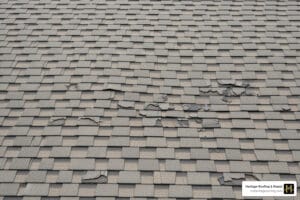
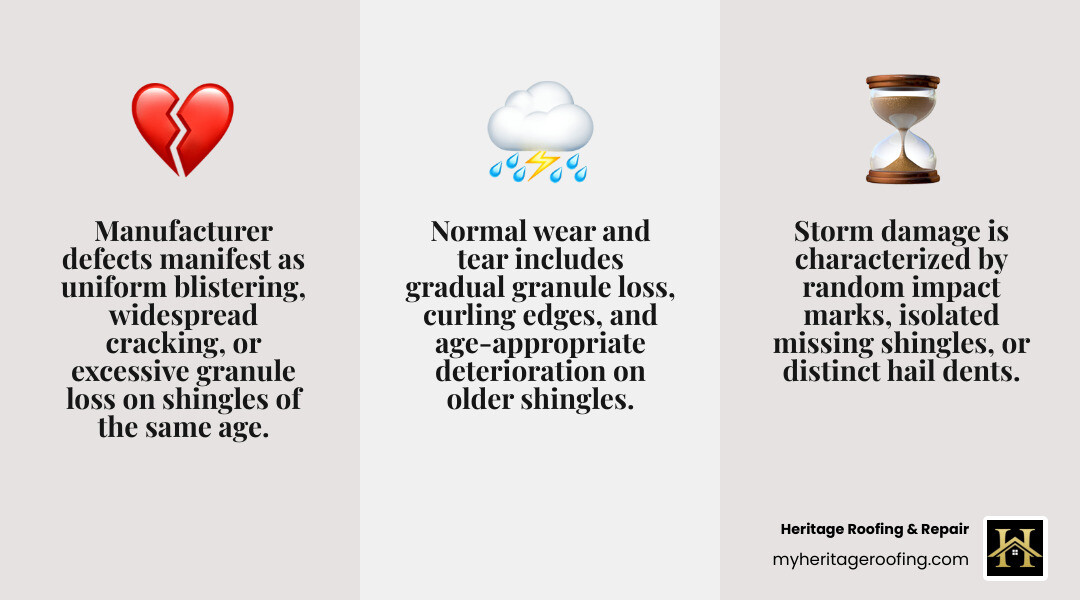
A roof should last 20 to 30 years. When serious problems appear in year seven, or even year two, it’s a red flag for a manufacturing defect. The key to a successful defective shingles insurance claim is recognizing uniform damage patterns across shingles from the same production batch. This consistency distinguishes defects from scattered storm damage.
Common signs of defective shingles include:
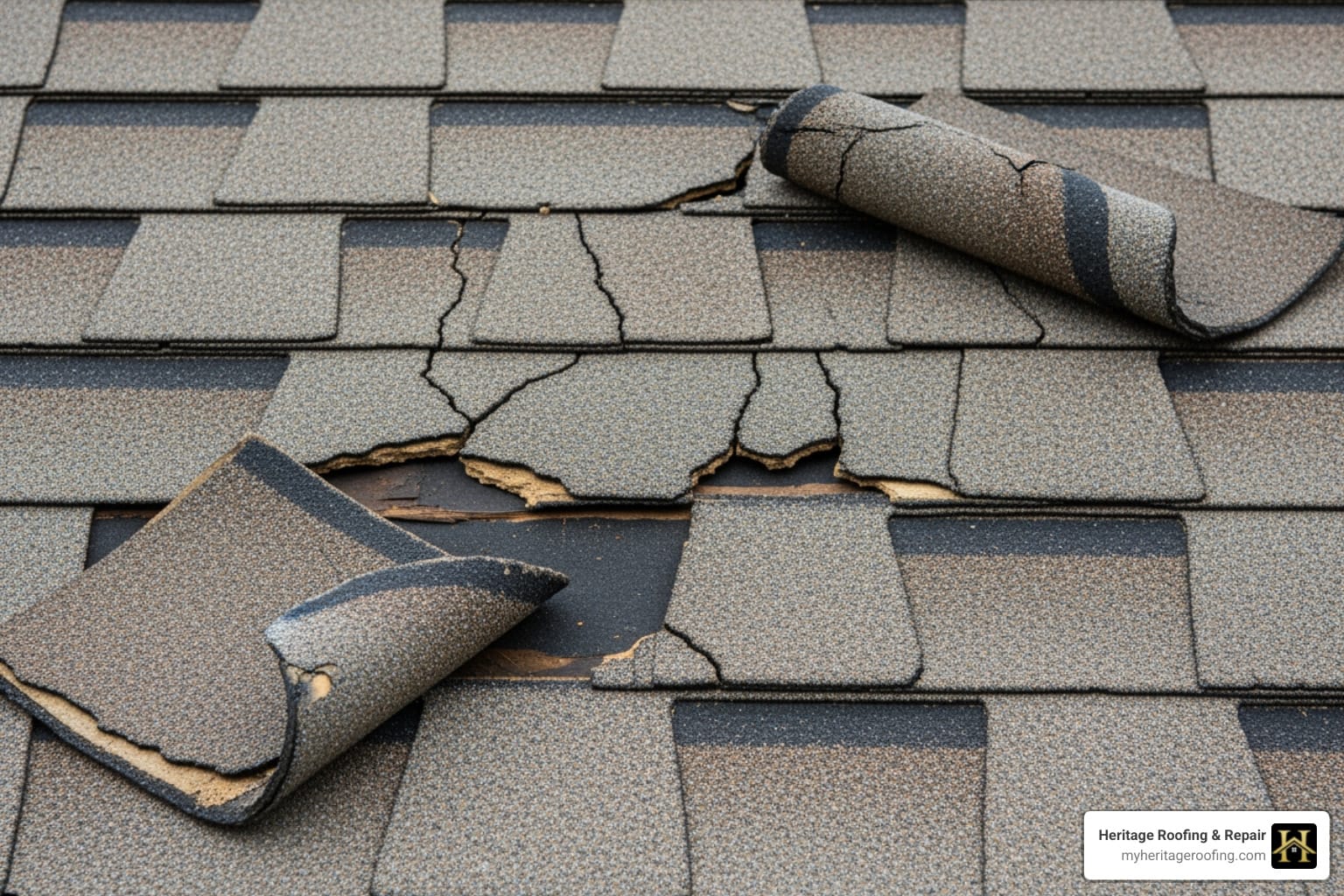
- Blistering: Widespread bubbles or raised spots caused by trapped moisture during manufacturing.
- Cracking: Extensive cracking across shingles of the same age, not just a few isolated spots on an old roof.
- Excessive Granule Loss: Gutters filling with shingle granules within 5-10 years of installation, unrelated to storms.
- Thermal Splitting: Cracks caused by temperature changes, indicating a flawed shingle composition unable to handle Arkansas weather.
These uniform patterns are different from the random impact marks of hail damage. While a 20-year-old roof with some curling is normal, a 5-year-old roof with widespread blistering is a defect.
How to Tell if Your Shingles Are Defective
Look for these visual cues from the ground and in your gutters:
- Uniform “blistering” that looks like bubbles under the shingle surface.
- Widespread cracking across shingles of similar age and sun exposure.
- Significant granule loss in gutters soon after installation.
- Brittle shingles that break easily when gently lifted.
The Critical Role of a Professional Roof Inspection
While you can spot obvious issues, a professional inspection is essential to build a solid claim. An expert provides three critical services:
- Identifies the Shingle Brand: This is necessary to check for warranties or known product issues.
- Documents the Failure: A professional creates detailed reports with photos and samples that insurance adjusters and manufacturers require as hard evidence.
- Provides an Unbiased Assessment: A licensed roofer can authoritatively distinguish manufacturing flaws from installation errors or storm damage—a distinction that can make or break your claim.
Professional documentation carries weight that personal observations do not. If you see these warning signs, getting an expert assessment quickly is the best way to strengthen your defective shingles insurance claim.
Manufacturer Warranty vs. Homeowners Insurance: Who Pays?
When facing a defective shingles insurance claim, it’s crucial to know who pays: the shingle manufacturer or your insurance company. The answer depends on the type of damage and your coverage.
A manufacturer’s warranty covers defects in the shingles themselves. However, these warranties are often prorated and typically only cover the cost of the materials, excluding labor, tear-off, and disposal fees. For a deeper dive, see our guide to understanding your roofing warranty.
Homeowners insurance covers sudden, accidental damage from “covered perils” like storms or fire. It explicitly excludes wear and tear and, usually, direct damage from faulty materials. The key is when a defect leads to a covered event. For example, if defective shingles crack and cause a leak, your policy might cover the resulting water damage but not the cost of replacing the faulty shingles.
Understanding Your Policy: ACV vs. RCV
Your payout is determined by whether you have an Actual Cash Value (ACV) or Replacement Cost Value (RCV) policy.
- ACV pays the depreciated value of your roof. A 10-year-old roof may have depreciated by 30-50%, significantly reducing your payout.
- RCV covers the full cost to replace your roof at today’s prices, though you often receive the depreciation amount only after repairs are complete.
For a visual explanation, this video explains ACV and RCV policies well.
| Feature | Manufacturer Warranty | Homeowner’s Insurance |
|---|---|---|
| Covers | Shingle material defects | Sudden, accidental damage (e.g., leaks) |
| Included | Cost of replacement shingles (often prorated) | Repairs if defect leads to a covered peril |
| Exclusions | Labor, installation errors, storm damage | Manufacturing defects, wear and tear |
| Payout Basis | Prorated based on age | ACV or RCV, based on policy |
| Proof Needed | Evidence of manufacturing flaw | Evidence of a covered peril causing damage |
Why Insurance May Deny a Claim for a Manufacturer Defect
Insurers often deny these claims for several reasons:
- Policy Exclusions: Most policies exclude damage from “faulty materials” or gradual deterioration.
- Wear and Tear: Adjusters may argue that the damage is normal aging, not a premature failure.
- Burden of Proof: The homeowner must prove the defect caused the damage, not poor installation or maintenance.
- Pre-existing Damage: Insurers may deny claims if you failed to address a known issue promptly, as they expect homeowners to mitigate damage. According to experts, insurers deny claims for pre-existing damage if they believe action should have been taken sooner.
The Step-by-Step Process for a Defective Shingles Insurance Claim
Following a clear roadmap for your defective shingles insurance claim can dramatically improve your chances of success.
- Document the Damage: The moment you suspect a defect, take dated photos and videos of all problem areas. Capture close-ups of blistering or cracking and wide shots showing the uniform pattern of damage.
- Schedule a Professional Inspection: A detailed report from a trusted roofer is your most powerful evidence. It will identify the shingle brand, assess the failure, and distinguish the defect from other issues.
- Review Your Policy: Before filing, understand your coverage limits, deductible, and whether you have an ACV or RCV policy.
- Contact the Manufacturer (If Applicable): For newer roofs, you may be able to file a claim directly with the manufacturer under the product warranty, though this often only covers materials.
- File Strategically with Your Insurer: Frame the claim around subsequent damage caused by the defect (e.g., a leak), which is more likely to be covered than the defect itself.
- Have Your Contractor at the Adjuster Meeting: An experienced roofer can advocate on your behalf, point out evidence, and ensure the damage isn’t dismissed as wear and tear.
- Review the Settlement Offer: Never accept an initial offer without reviewing it with your contractor to ensure it covers a complete roof replacement if necessary.
For more guidance, see our guide on navigating the claims process with an adjuster.
What Documentation Supports a Defective Shingles Insurance Claim?
A successful claim requires strong evidence. Gather the following:
- Proof of Ownership and your insurance policy.
- Original Installation Contract: Shows the date, contractor, and shingle product line.
- Dated Photos and Videos: Your primary visual evidence of the damage and its extent.
- Professional Inspection Report: An expert assessment explaining why the damage is a manufacturing defect.
- Detailed Repair Estimates: Itemized costs for all necessary work, from tear-off to labor.
- Records of Regular Roof Maintenance: This helps counter claims of neglect from the insurer.
Working with the Insurance Adjuster and Your Contractor
The insurance adjuster works for the insurance company, not for you. Their goal is to assess damage according to the policy while protecting the insurer’s financial interests.
This is why having your contractor present during the adjuster’s visit is invaluable. We speak the adjuster’s language, understand estimating software like Xactimate, and can challenge an incorrect assessment on the spot. An adjuster might mistake premature failure for normal aging, but your contractor can provide the technical explanation to prove it’s a defect. This advocacy ensures you receive a fair assessment for the work truly needed to protect your home.
Navigating Claim Denials and Legal Precedents
Many defective shingles insurance claims are initially denied. Understanding the common reasons is the first step to a successful appeal. Insurers often cite wear and tear, improper installation, insufficient evidence, or policy exclusions for faulty materials. The burden of proof is on you to show the defect caused insurable damage, like a leak.
Common Challenges with a Defective Shingles Insurance Claim
Beyond denial, you may face other problems:
- Proving Causation: You must establish a clear link between the defect and the resulting damage.
- Roof Age: It is much harder to get a claim approved for a 15-year-old roof than for a 7-year-old roof, as insurers will default to a “wear and tear” argument.
- Discontinued Shingles: If your shingles are no longer made, matching them for a repair is impossible. This can strengthen the case for a full replacement but requires negotiation.
- Poor Maintenance Accusations: Insurers may blame neglect. Records of regular roof care are your best defense.
What to Do If Your Claim Is Denied
A denial is not the final word. Take these steps to appeal the decision:
- Request the Denial in Writing: The letter must state the specific reasons and cite the policy language used to deny the claim.
- Review Your Policy: Read the cited sections carefully. Insurers can misinterpret their own policies.
- Gather More Evidence: Work with your contractor to get engineering reports or even lab analysis of shingle samples to strengthen your case.
- Invoke the Appraisal Process: If you disagree on the cost of damage, most policies allow you to use a third-party appraisal process to get a binding decision.
- Hire a Public Adjuster or Attorney: For complex cases, a public adjuster who works for you or an attorney specializing in insurance claims may be necessary.
For a complete walkthrough, consult our guide on what to do if your claim is denied. Persistence and professional support are key.
Get Local Expertise for Your Arkansas Roof Claim
Ignoring defective shingles invites serious damage. What begins as a cosmetic issue can lead to water intrusion, attic rot, and interior mold growth—a significant health risk and a major problem when selling your home. These issues can cost tens of thousands in structural repairs.
Prevention is key: choose quality materials and ensure proper installation by a certified contractor. For homeowners in the Harrison, AR area and across Northwest Arkansas, local knowledge is critical. Our climate’s intense heat, humidity, and severe storms expose shingle defects faster than in other regions.
At Heritage Roofing & Repair, we have over 50 years of experience with these specific challenges. We know the local building codes, the common shingle failures in our weather, and how to build a strong defective shingles insurance claim that local adjusters will approve. Whether you need an honest assessment or help with a denied claim, our local expertise is your advantage.
Heritage Roofing & Repair
3458 Arkansas State Hwy 221, Berryville, AR 72616
(870) 654-1164
Frequently Asked Questions about Defective Shingle Claims
Can I file an insurance claim for old shingles?
An insurance claim is typically not approved for a roof that is simply old or has reached the end of its expected lifespan. Homeowners insurance covers sudden, accidental damage from specific events (perils), not gradual deterioration or wear and tear. However, if old shingles fail prematurely due to a manufacturing defect that leads to damage, you may have a case, though it can be challenging to prove. The age of the roof is a significant factor in claim approval and payout, with older roofs often subject to ACV policies.
How much does a roof devalue per year for insurance?
Roof depreciation rates vary by insurance company, policy type (ACV vs. RCV), and roofing material. However, a common rate for asphalt shingles is between 3% and 5% per year. This means a 10-year-old roof could be considered to have lost 30-50% of its value on an Actual Cash Value (ACV) policy. This depreciation directly impacts the amount you receive if your policy is ACV.
What is the difference between a manufacturer’s warranty and a workmanship warranty?
A manufacturer’s warranty covers defects in the roofing materials themselves, such as shingles that crack or lose granules prematurely due to a flaw in their production. This warranty comes from the company that made the shingles. A workmanship warranty, on the other hand, is provided by the roofing contractor and covers errors made during the installation process, like improper nailing or flashing installation that leads to leaks. Both are crucial for comprehensive roof protection.
Protect Your Home with an Expert Partner
Your roof protects everything you value. When defective shingles threaten that protection, you need an expert partner who understands the complexities of the claims process.
A successful defective shingles insurance claim depends on early identification, thorough documentation, and expert advocacy. Insurance companies are not eager to pay for manufacturing defects and will often attribute the damage to aging or poor maintenance. A detailed inspection report and a paper trail of evidence are your most powerful tools.
However, documentation alone isn’t always enough. You need an advocate who can speak the language of adjusters, challenge lowball offers, and negotiate a fair settlement.
Heritage Roofing & Repair has spent over 50 years helping Arkansas homeowners steer these exact situations. We’ve seen countless manufacturing defects and know how to guide claims from initial inspection to a successful resolution. Don’t let a defect compromise your home’s safety or value. The problem will only get worse, and the secondary damage can be far more costly than a new roof.
Whether you’re just noticing damage or have already been denied, we are here to help you through the process with the expertise that comes from half a century of trusted service. For a complete overview, consult our ultimate guide to roofing insurance claims. You don’t have to face this alone.