Why Hiring the Right Commercial Roofing Contractor in Fayetteville, AR Can Save Your Business Thousands
Finding a commercial roofing contractor in Fayetteville, AR that combines quality work with fair pricing is one of the most important decisions a local business owner can make. Northwest Arkansas businesses face some of the most demanding weather in the region — and your roof is the first line of defense. That is why partnering with a trusted Northwest Arkansas roofing company is essential to protect your commercial investment from premature wear and costly storm damage.
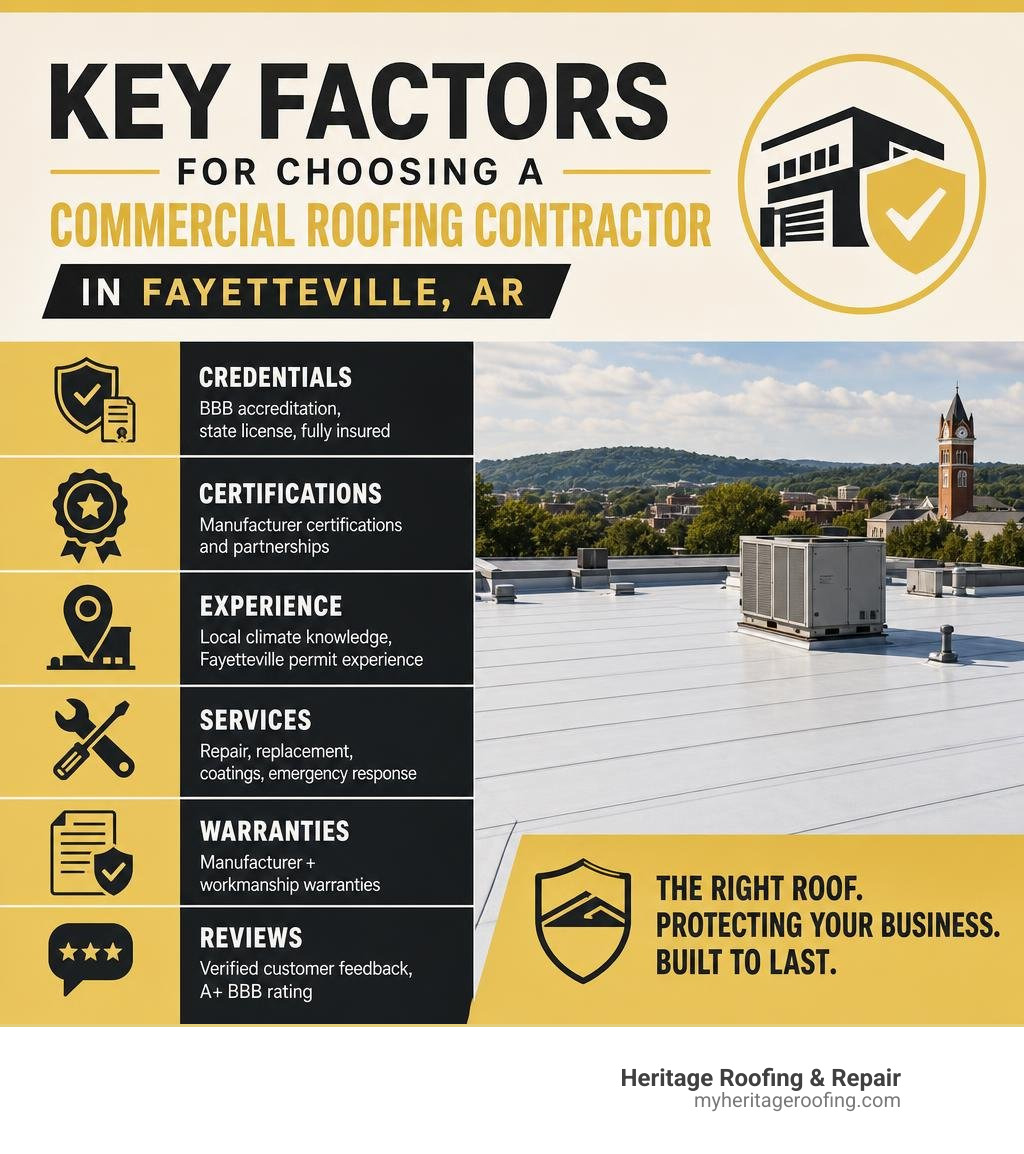
Quick Answer: What to Look for in a Fayetteville Commercial Roofing Contractor
| Factor | What to Check |
|---|---|
| Credentials | BBB accreditation, state license, fully insured |
| Certifications | GAF Master Elite, manufacturer partnerships |
| Experience | Local climate knowledge, Fayetteville permit experience |
| Services | Repair, replacement, coatings, emergency response |
| Warranties | Manufacturer + workmanship warranties offered |
| Reviews | Verified customer feedback, A+ BBB rating |
Fayetteville sits in the Ozark foothills, which means sharper freeze-thaw cycles, heavier spring rainfall (around 48 inches annually), and serious hail risk — all of which accelerate roof wear on commercial buildings. A roof that might last 20 years in a milder climate can fail in 12 if it’s the wrong system or poorly installed.
The cost stakes are real. A full commercial roof replacement can run tens of thousands of dollars. But with the right contractor and the right system, many building owners can save 40–70% through restoration and coating solutions instead of tearing everything off and starting over.
That’s exactly why choosing a local expert who knows local codes, local weather, and local building types matters far more than simply picking the lowest bidder.
I’m Rex Wisdom, owner of Heritage Roofing & Repair, a family-owned business that has served Northwest Arkansas communities for over 50 years as a hands-on commercial roofing contractor in Fayetteville, AR and the surrounding region. Our team handles everything from storm damage repairs and insurance claims to full commercial roof replacements and preventive maintenance programs — built around what actually works in this climate.
Local Office Contact Information
Heritage Roofing & Repair
3458 Arkansas State Hwy 221, Berryville, AR 72616
Phone: (870) 654-1164
Commercial roofing contractor fayetteville ar helpful reading:
Key Challenges for a Commercial Roofing Contractor in Fayetteville, AR
Operating a business in Fayetteville, AR, means dealing with a highly volatile climate. The Ozark Mountains create a microclimate characterized by rapid temperature swings, high humidity, and intense storm systems. For commercial roofing systems, these conditions present unique structural challenges that require specialized local knowledge.
Freeze-Thaw Cycles
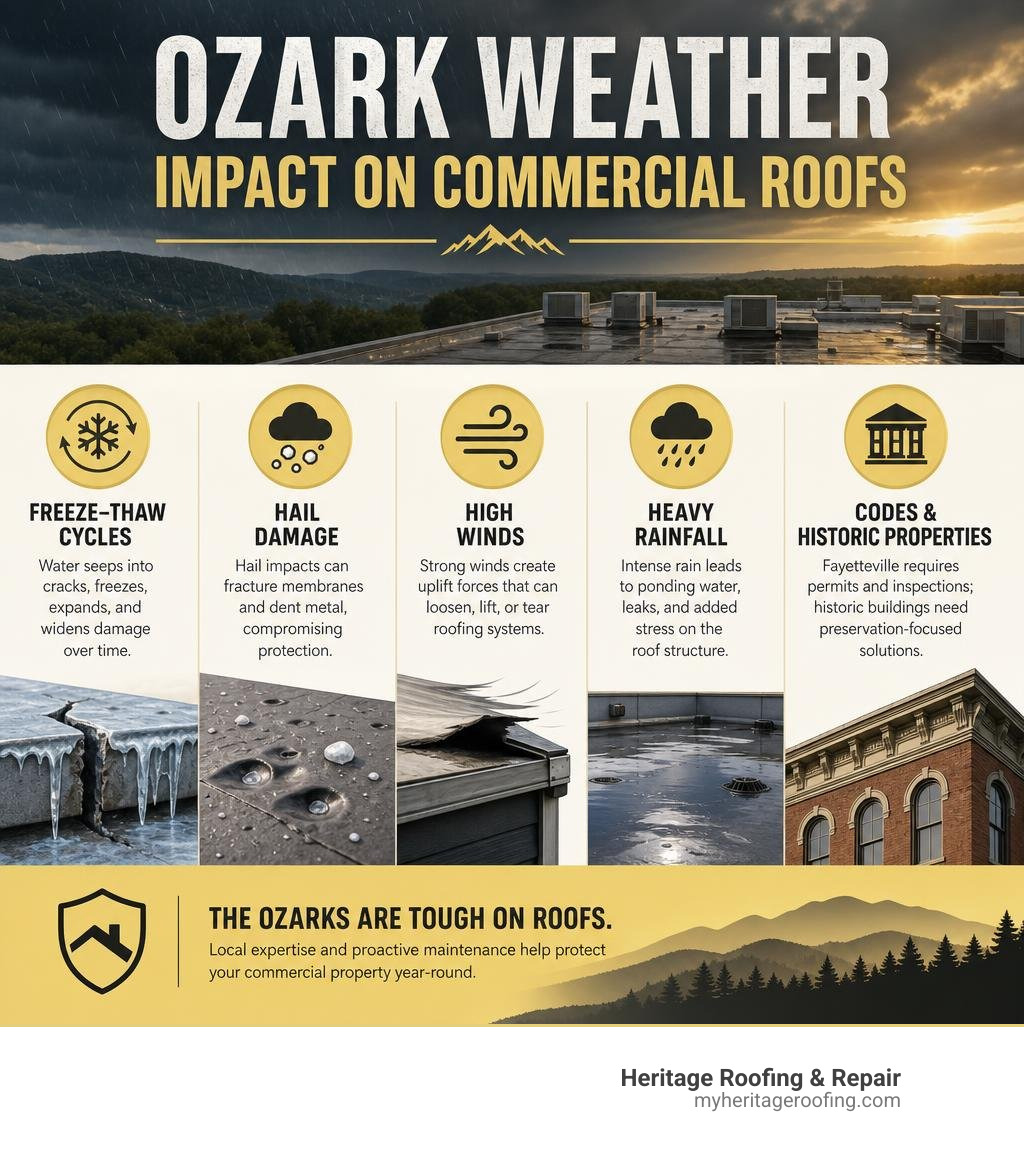
Fayetteville’s elevation causes colder winter temperatures and more frequent freeze-thaw cycles than other parts of Arkansas. When water penetrates minor cracks or open seams during a winter rain, it expands as it freezes. This expansion widens the cracks, damages the flashings, and splits sealants. Over a single winter, repeated freeze-thaw cycles can turn a minor, undetected seam separation into a major interior leak.
Hail Damage
Northwest Arkansas is highly susceptible to severe spring and summer thunderstorms that bring large hail. Hail stones impact flat and low-slope roofing membranes with incredible force, fracturing the fiberglass scrim inside single-ply membranes or creating micro-fractures in asphalt-based systems. For metal roofs, hail causes severe denting that can compromise the structural integrity of the panels and ruin the protective coatings.
High Winds
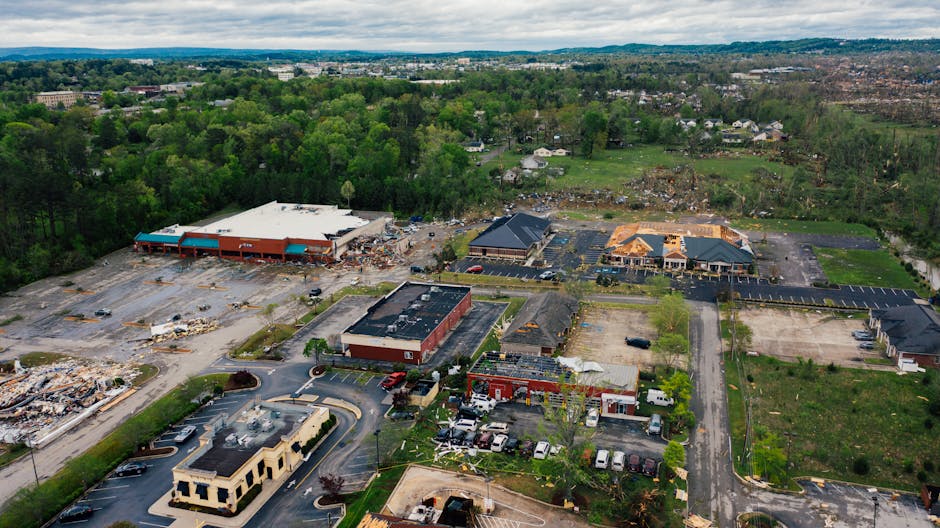
Fayetteville is no stranger to high-wind events, including severe straight-line winds and tornadoes. These winds create low-pressure zones above flat roofs, literally trying to suck the roofing membrane off the deck. A local contractor must ensure that the roof’s edge metal, flashings, and membrane fastening patterns comply with strict wind uplift ratings designed for the Ozark region.
Heavy Rainfall
With an average of 48 inches of annual rainfall concentrated in intense spring storms, Fayetteville commercial roofs must handle massive volumes of water. If a roof has poor drainage, clogged scuppers, or improper sloping, water ponds on the surface. Ponding water adds thousands of pounds of dead weight to the structural deck and accelerates the deterioration of the roofing membrane.
Fayetteville Building Codes, Permits, and Historic Properties
The City of Fayetteville enforces strict building codes to ensure safety and energy efficiency. Any commercial roof replacement requires a city permit, plan review, and a final inspection. Furthermore, Fayetteville is home to several historic commercial districts, including properties around the historic Downtown Square. Working on these historic buildings requires strict adherence to preservation guidelines, matching historic architectural styles, and coordinating with the local historic district commission.
Cost-Effective Commercial Roofing Systems and Materials
Choosing the right material is the single most important factor in balancing upfront installation costs with long-term energy savings and durability.
| Material Type | Average Lifespan | Hail Resistance | Energy Efficiency | Best Suited For |
|---|---|---|---|---|
| TPO (Thermoplastic Polyolefin) | 15–25 Years | High | Excellent (Highly Reflective) | Retail, offices, and heated warehouses |
| PVC (Polyvinyl Chloride) | 20–30 Years | Very High | Excellent (Chemical Resistant) | Restaurants, manufacturing, and flat roofs |
| EPDM (Rubber) | 20–35 Years | High | Moderate (Absorbs Heat) | Large industrial warehouses, low-slope roofs |
| Metal Roofing | 40–60 Years | Extremely High | High (With Reflective Coatings) | Architectural buildings, steep-slope commercial |
Single-Ply Membranes
Single-ply membranes are the most common choice for modern flat and low-slope commercial buildings in Fayetteville. They offer a great balance of affordability, ease of installation, and weather resistance.
- TPO Roofing: Thermoplastic Polyolefin (TPO) is a single-ply reflective membrane that is highly popular for commercial properties. Because it is white, it reflects UV rays away from the building, significantly lowering summer cooling costs. The seams are hot-air welded, creating a physical bond that is up to four times stronger than taped seams.
- PVC Roofing: Polyvinyl Chloride (PVC) is exceptionally durable and highly resistant to chemicals, grease, and fire. This makes PVC the premier choice for restaurants, food processing plants, and manufacturing facilities where grease or chemicals are vented onto the roof. Like TPO, PVC has hot-air welded seams that resist freeze-thaw cycles and high winds.
- EPDM Roofing: Ethylene Propylene Diene Monomer (EPDM) is a synthetic rubber membrane known for its extreme durability. It handles extreme temperature swings without cracking. However, because EPDM is traditionally black, it absorbs heat rather than reflecting it, which can increase cooling costs in the hot Arkansas summers unless a reflective coating is applied.
Metal Roofing
Metal roofing systems are highly durable and offer an incredibly long lifespan of up to 60 years. They are highly resistant to wind, hail, and fire. While the initial installation cost is higher than single-ply membranes, metal roofs require very little maintenance and can be coated repeatedly to extend their life indefinitely, making them highly cost-effective over their lifespan.
Energy Efficiency and Cost Savings
Modern commercial roofing systems are designed to act as “cool roofs.” By reflecting solar radiation, a cool roof can reduce the roof surface temperature by up to 50°F during hot summer days. This directly translates to lower HVAC load, reducing commercial energy bills by 15% to 30%. When planning your project, exploring comprehensive commercial roofing services will help you select a system that maximizes both local utility rebates and long-term energy savings.
Key Credentials to Verify Before Hiring
Selecting a contractor is just as critical as choosing the right material. A poorly installed premium roof will fail faster than a properly installed budget roof.
- Verify BBB Accreditation: Always verify the contractor’s standing with the Better Business Bureau. Look for an A+ rating and read customer reviews to ensure they have a history of resolving issues and maintaining open communication.
- Confirm GAF Master Elite Status: GAF is North America’s largest roofing manufacturer. Only a small percentage of roofing contractors achieve GAF Master Elite status. Working with a certified GAF contractor allows you to access exclusive, high-tier manufacturer warranties that cover both materials and installation workmanship.
- Understand Manufacturer Warranties: Ask about the differences between standard material warranties and comprehensive system warranties, such as the GAF Golden Pledge. A system warranty guarantees that the manufacturer will cover repair costs if the roof fails due to installation errors or material defects.
- Check Local Licenses and Insurance: Ensure the contractor holds a valid Arkansas commercial contractor’s license and carries comprehensive general liability and workers’ compensation insurance to protect your business from liability during the project.
Commercial Roof Restoration vs. Full Replacement
For many Fayetteville business owners, a failing roof does not automatically mean you need to pay for a full tear-off and replacement. Roof restoration is a highly effective, budget-friendly alternative.
Roof Coatings
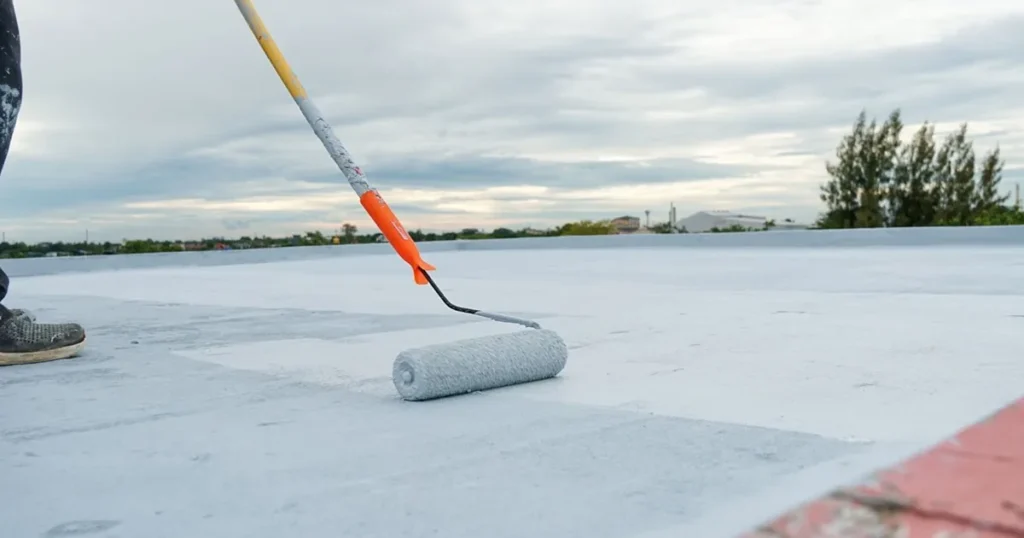
Roof restoration involves applying a high-performance liquid coating directly over your existing commercial roof membrane. The most common coatings are silicone and acrylic.
- Silicone Coatings: Silicone is highly resistant to ponding water and UV degradation. It creates a seamless, monolithic membrane that seals leaks and protects the building from severe weather.
- Acrylic Coatings: Acrylic is highly reflective and cost-effective, making it ideal for sloped metal roofs or areas with excellent drainage.
Spray Polyurethane Foam (SPF)
Spray foam is applied as a liquid that expands into a solid, seamless foam barrier. It provides exceptional insulation (R-value) while sealing all cracks, seams, and penetrations. It is highly effective for flat roofs that need improved drainage and thermal performance.
Cost Savings and Business Disruption
Restoration systems typically cost 40% to 70% less than a full roof replacement. Because there is no tear-off process, there are no landfill disposal fees, and business disruption is virtually zero. Your daily operations can continue completely uninterrupted while the coating is applied.
Lifespan Extension
A professionally applied roof coating can extend the life of your commercial roof by 10 to 20 years. Best of all, when the coating finally begins to wear down, the roof can simply be cleaned and re-coated, starting the cycle over again without ever needing a costly tear-off. To determine if your roof qualifies, read our commercial roof coating guide and compare it against our commercial flat roof replacement guide.
Proactive Maintenance and Storm Damage Support
The most cost-effective way to manage your commercial roof is to prevent major problems before they occur. Implementing a proactive maintenance plan saves thousands of dollars in emergency repairs.
- Preventative Maintenance & Semi-Annual Inspections: We recommend inspecting commercial roofs twice a year—once in the spring after the winter freeze-thaw cycles, and once in the fall before the first freeze. This allows us to clear drains, reseal deteriorating flashings, and catch minor leaks before they damage your building’s interior.
- Leak Prevention: Keeping scuppers, gutters, and roof drains clear of debris is the simplest, most effective way to prevent ponding water and structural damage.
- Storm Damage Documentation: After a major severe weather event in Fayetteville, document any visible damage immediately. Take photos of hail impact, wind-torn metal, or interior water stains.
- Insurance Claims Assistance: Filing a commercial insurance claim can be incredibly complex. Working with an experienced local contractor ensures you have detailed damage reports, roof core samples, and professional estimates to present to your insurance adjuster. To streamline this process, consult our commercial roof insurance claims guide to protect your business investment.
Frequently Asked Questions About Commercial Roofing
How much can I save by choosing a roof coating over a full replacement?
Choosing a roof coating over a full replacement typically saves business owners between 40% and 70% in total project costs. Because a coating is applied directly to the existing roof, you completely avoid the labor costs of tearing off the old roof, disposal fees at local landfills, and the need to purchase entirely new structural insulation. Additionally, roof coatings are classified as a maintenance expense rather than a capital improvement, which can provide significant tax advantages in the first year.
Does the City of Fayetteville require a permit for commercial roof replacement?
Yes, the City of Fayetteville requires a building permit for all commercial roof replacements. A licensed commercial contractor must submit the project plans to ensure compliance with current building and energy codes, including wind uplift ratings and insulation R-value requirements. A reputable contractor will handle the entire permitting process, coordinate inspections, and ensure the final project is fully compliant with local regulations.
How often should a commercial roof in Northwest Arkansas be inspected?
A commercial roof in Northwest Arkansas should be inspected at least twice a year. The ideal times are in the spring (to identify and repair any damage caused by winter freeze-thaw cycles) and in the autumn (to prepare the roof and clear drainage systems before winter weather sets in). Additionally, you should schedule a professional inspection immediately following any major severe weather event, such as a severe hailstorm or high-wind event, to document any storm damage for insurance purposes.
Conclusion
Protecting your Fayetteville commercial property doesn’t have to break the bank. By choosing the right materials, staying proactive with semi-annual inspections, and utilizing advanced restoration coatings, you can extend the lifespan of your roof while keeping your capital reserves intact.
At Heritage Roofing & Repair, we bring over 50 years of trusted local experience, quality craftsmanship, and dedicated storm damage expertise to every project. We are committed to delivering dependable, affordable commercial roofing solutions tailored specifically to the unique climate of Northwest Arkansas. Contact us today to schedule a free, honest, and transparent roof evaluation.