Why Modified Bitumen Roofing Dominates the Commercial Flat Roof Market in 2026
Modified bitumen roofing is the go-to flat roof system for commercial buildings — and for good reason. If you’re comparing roofing options for a low-slope or flat roof, here’s what you need to know upfront:
Quick Answer: What Makes Modified Bitumen Roofing the Best Choice?
| Feature | What It Means for You |
|---|---|
| Durability | Multi-layer system up to 380 mils thick — far tougher than single-ply alternatives |
| Lifespan | 20 to 30 years with proper maintenance |
| Cost | $5 to $12 per square foot installed |
| Flexibility | Handles temperature swings from -20°F to 300°F depending on membrane type |
| Installation options | Torch-applied, cold-adhered, self-adhered, or mechanically fastened |
| Repairability | Easy to patch and restore without full replacement |
Choosing the right roof for a flat or low-slope commercial building is one of the most important — and expensive — decisions a property owner makes. Get it wrong, and you’re dealing with leaks, premature failures, and costly replacements far sooner than expected. Get it right, and your roof quietly does its job for decades.
This guide walks you through everything you need to make a confident decision — membrane types, installation methods, costs, lifespan, and how it stacks up against the competition. Whether you’re dealing with storm damage, an aging roof, or planning a new build, our professional roofing services at Heritage Roofing & Repair are here to help you get it right the first time.
I’m Rex Wisdom, owner of Heritage Roofing & Repair, a family-owned business with over 50 years of collective roofing experience serving Berryville and communities throughout Northwest Arkansas — including hands-on work with modified bitumen roofing systems on commercial and residential flat roofs across the region. In this guide, I’ll share what we’ve learned from decades in the field so you can make the smartest choice for your property.
Common modified bitumen roofing vocab:
What is Modified Bitumen Roofing?

At its core, modified bitumen roofing is an evolution of traditional asphalt roofing. We often call it “mod bit” for short. It is a asphalt-based roofing system designed specifically for buildings with flat roof systems or very low slopes.
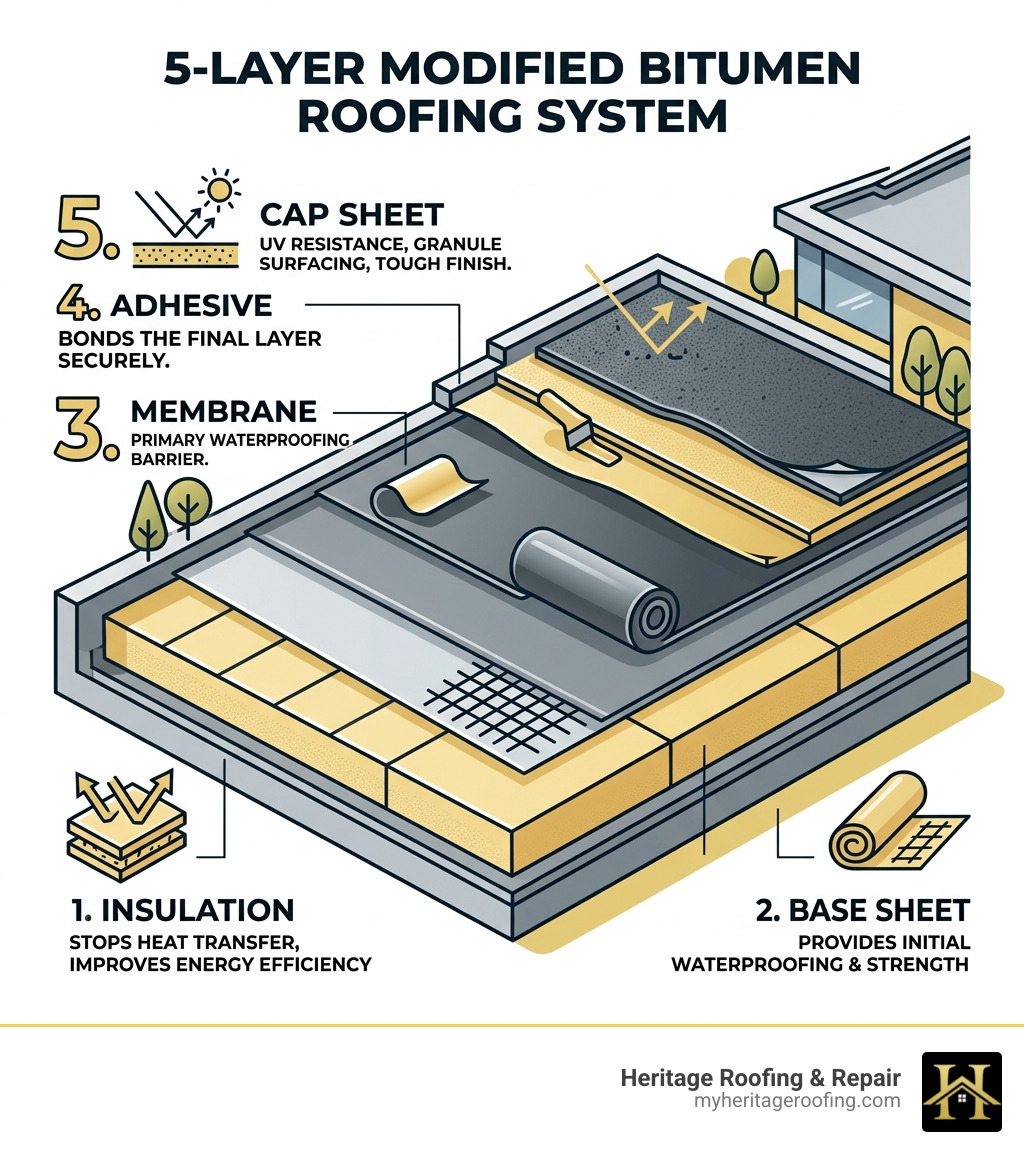
What makes it “modified” is the addition of polymerized rubber or plastic modifiers to the asphalt. These modifiers are blended with high-quality bitumen and then reinforced with a “scrim” or fabric layer, usually made of fiberglass or polyester. This combination results in a membrane that is both rugged and incredibly flexible.
According to industry experts, these membranes are significantly thicker than modern single-ply roofs. While a standard TPO roof might only be 40 to 80 mils thick, a self-adhered mod bit system typically ranges from 180 to 380 mils. That extra thickness provides a substantial barrier against the elements.
The Multi-Ply Strength of Modified Bitumen Roofing
The secret to the success of modified bitumen roofing is its redundancy. Unlike single-ply systems where one small puncture can lead to a major leak, mod bit is almost always installed in multiple layers. This multi-ply approach provides exceptional tensile strength and puncture resistance.
A typical sheet of modified bitumen weighs about 1.1 lbs per square foot, and when you combine two or three plies, you are creating a roofing armor that is roughly 300 mils thick. This makes it the ideal choice for roofs that see heavy foot traffic, such as those housing HVAC units or rooftop decks. For a deeper dive into why thickness matters, check out our commercial flat roof ultimate guide.
Evolution from Built-Up Roofing (BUR)
To understand mod bit, you have to look at its “cousin,” Built-Up Roofing (BUR). BUR has been used for over a century and involves mopping down multiple layers of felt and hot tar. While effective, BUR is labor-intensive, heavy, and creates significant fumes.
In the 1960s, European researchers looked for a way to simplify this process while keeping the durability of asphalt. By adding synthetic polymers to the mix, they created a factory-manufactured roll that offered better temperature stability and easier installation. By the mid-1990s, it had captured roughly 35% of the U.S. roofing market. Today, it still accounts for around 10% of all new low-slope installations because it offers the same multi-layer protection with much higher efficiency.
SBS vs. APP: Choosing the Right Membrane for Your Climate
Not all modified bitumen is created equal. The two primary types are SBS and APP, and choosing the wrong one for the Arkansas climate can lead to premature failure.
| Feature | SBS (Styrene-Butadiene-Styrene) | APP (Atactic Polypropylene) |
|---|---|---|
| Modifier Type | Synthetic Rubber | Plastic |
| Best For | Cold climates & high thermal movement | Hot climates & intense UV |
| Flexibility | High (like a rubber band) | Lower (more rigid) |
| Application | Cold adhesive, hot mop, or self-adhered | Torch-applied |
| Temp Range | Flexible down to -20°F | Melts at approx. 300°F |
SBS Membranes for Flexible Performance
SBS membranes use a rubberized asphalt formula. We like to compare it to a heavy-duty rubber band; it can stretch and then snap back to its original shape without tearing. This is vital for buildings that experience significant thermal expansion and contraction.
In Northwest Arkansas, where we can see temperatures drop significantly in the winter, SBS is often the preferred choice because it remains flexible down to -20°F. This prevents the “alligatoring” or cracking that can plague older asphalt systems. For more technical details on membrane selection, Roof Online provides a great breakdown of material standards.
APP Membranes for High-Heat Resistance
APP membranes are modified with a plastic polymer that gives the asphalt a higher melting point (around 300°F). Think of APP as a tough plastic shield. It excels in environments with intense sun and high heat—perfect for those brutal Arkansas summers.
APP is almost always torch-applied, which creates a very strong, fused seam. This rigidity makes it highly resistant to UV degradation and foot traffic scuffing. If your roof is in a high-heat area with little shade, APP is a rugged defense that won’t soften or flow under the sun.
Professional Installation Methods and Safety Standards
One of the reasons modified bitumen roofing is so versatile is the variety of installation methods available. At Heritage Roofing & Repair, we select the method that best fits your building’s structure and your business’s needs during a commercial flat roof installation.
- Torch-Applied: The back of the membrane is heated with a propane torch, melting the asphalt so it fuses to the substrate. While it creates the strongest seams, it requires strict fire safety protocols and a “fire watch” for at least an hour after work ends.
- Cold-Applied Adhesive: Membranes are set into a liquid “glue.” This is a great low-odor option for occupied buildings like schools or hospitals where propane fumes would be a nuisance.
- Self-Adhered (Peel-and-Stick): These membranes have a factory-applied adhesive on the back. They are fast to install and eliminate the need for torches or hot kettles, though they generally require temperatures above 40°F for a proper bond.
- Hot-Mopped: Similar to traditional BUR, SBS membranes can be installed using hot asphalt.
Long-Term Maintenance for Modified Bitumen Roofing
Even the toughest roof needs a little love. We recommend flat roof preventative maintenance via semi-annual inspections—ideally in the spring and fall.
During an inspection, we look for:
- Seam Integrity: Ensuring the edges of the rolls haven’t pulled apart.
- Ponding Water: Standing water that lasts more than 48 hours can degrade the asphalt and granules.
- Granule Loss: The ceramic granules on the top layer protect the membrane from UV rays. If they are washing away, the roof is nearing the end of its life.
If your mod bit roof is aging but still structurally sound, we can often apply an elastomeric coating to reflect heat and extend the lifespan by another 10 years.
Performance Comparison: Modified Bitumen vs. TPO and EPDM
Property owners often ask us how mod bit compares to single-ply systems like TPO or EPDM. Here is the breakdown:
- Durability: Mod bit wins. Due to its multi-ply nature and superior thickness, it is much harder to puncture than standard single-ply membranes.
- Installation: TPO and EPDM are often faster to install, which can lead to lower initial labor costs.
- Foot Traffic: If you have technicians walking on your roof regularly to service HVAC units, mod bit is the superior choice for flat roofs and big business in northwest arkansas.
- Lifespan: Both can last 20-30 years, but mod bit is often easier to repair using standard roofing cements and patches.
Frequently Asked Questions about Modified Bitumen
Can modified bitumen be installed in cold weather?
Yes, but it requires expertise. SBS membranes are better for cold-weather installs due to their flexibility. However, most adhesives struggle to bond below 40°F. In the winter, we often use hot-air welders or specialized cold-weather primers to ensure the system reaches its full bond strength.
Contact Heritage Roofing & Repair
Heritage Roofing & Repair 3458 Arkansas State Hwy 221, Berryville, AR 72616
Conclusion
At Heritage Roofing & Repair, we’ve seen every type of flat roof failure imaginable over our 50 years of experience. Time and again, modified bitumen roofing proves itself as one of the most dependable, repairable, and rugged systems available for the Arkansas climate. Whether you are in Berryville, Harrison, or anywhere in Northwest Arkansas, choosing a multi-ply system is a smart investment in your property’s future.
Our team is ready to provide an honest assessment of your current system, offering quality commercial roofing craftsmanship and expert insurance claim assistance for your next project.