Your Roof Is Only as Strong as What’s Beneath It
Roof deck repair is one of the most critical — and most overlooked — structural services a homeowner can invest in. The roof deck (also called roof sheathing) is the rigid panel layer that sits between your rafters and your shingles. It holds everything together. When it fails, your entire roofing system is at risk. As a trusted roofing company in Berryville, Heritage Roofing & Repair provides the structural expertise needed to keep your home safe and dry.
If you’re dealing with sagging, leaks, soft spots, or storm damage, this guide provides the essential information you need to address the problem before it escalates. We will explore:
- Repair Costs: A breakdown of pricing based on damage severity and material choice.
- Structural Decisions: When to choose a patch versus a full deck replacement.
- Root Causes: Identifying the primary sources of wood rot and structural failure.
- Professional Standards: Why structural repairs require specialized contractor expertise.
- Insurance Insights: Navigating the claims process for sudden storm damage.
A damaged roof deck doesn’t have to turn into a full-blown crisis — but only if it’s caught early. Left unaddressed, moisture works its way into the wood fiber, rot spreads silently, and what started as a $300 patch job can quietly become a $15,000 structural overhaul.
I’m Rex Wisdom, owner of Heritage Roofing & Repair, a family-owned business serving Berryville and Northwest Arkansas for over 50 years — and roof deck repair is one of the most common structural problems our crews diagnose after storms, aging, and deferred maintenance. In this guide, I’ll walk you through everything you need to make a confident, informed decision about your roof deck.
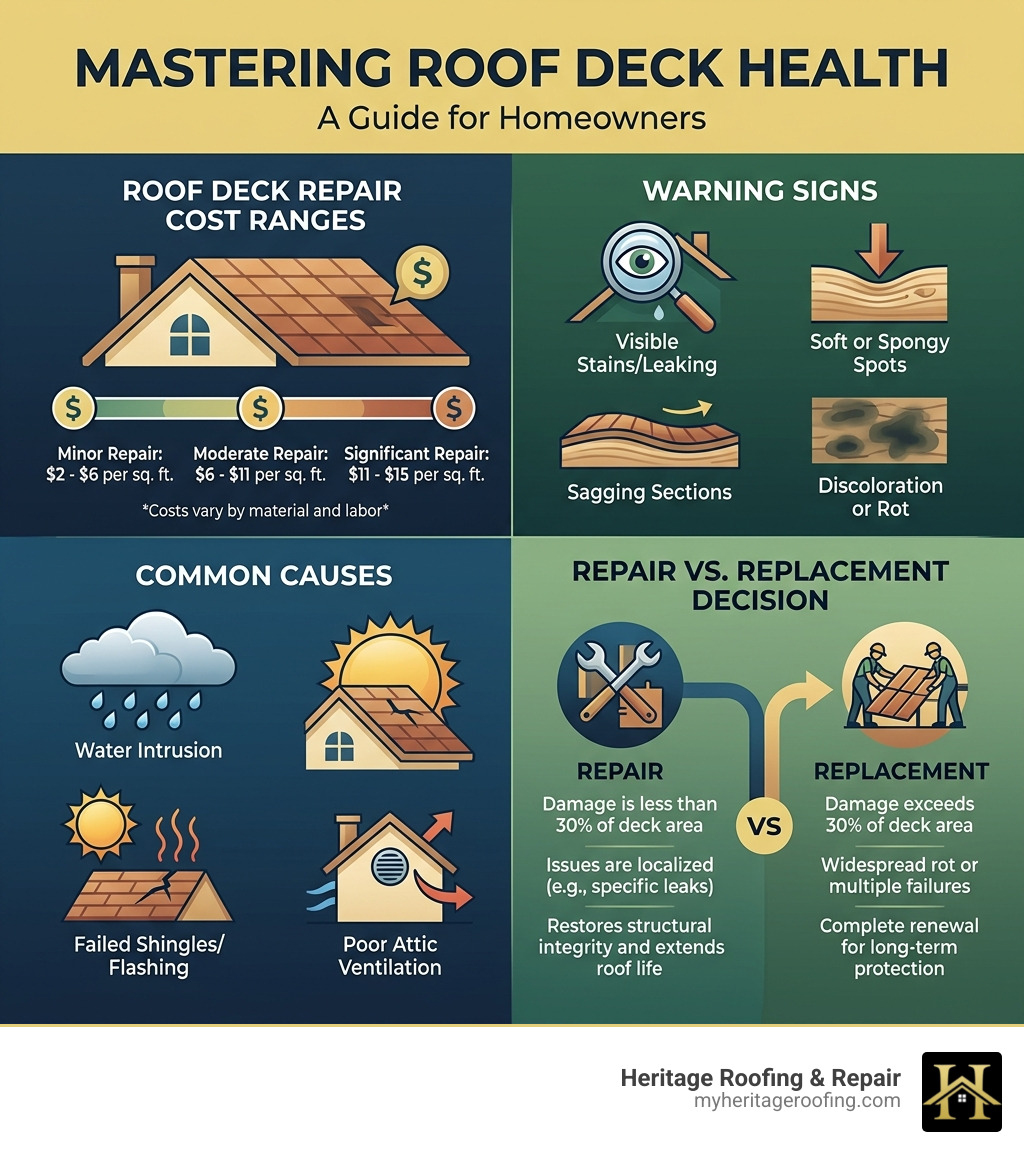
Roof deck repair terms you need:
Understanding the Foundation: What is a Roof Deck?
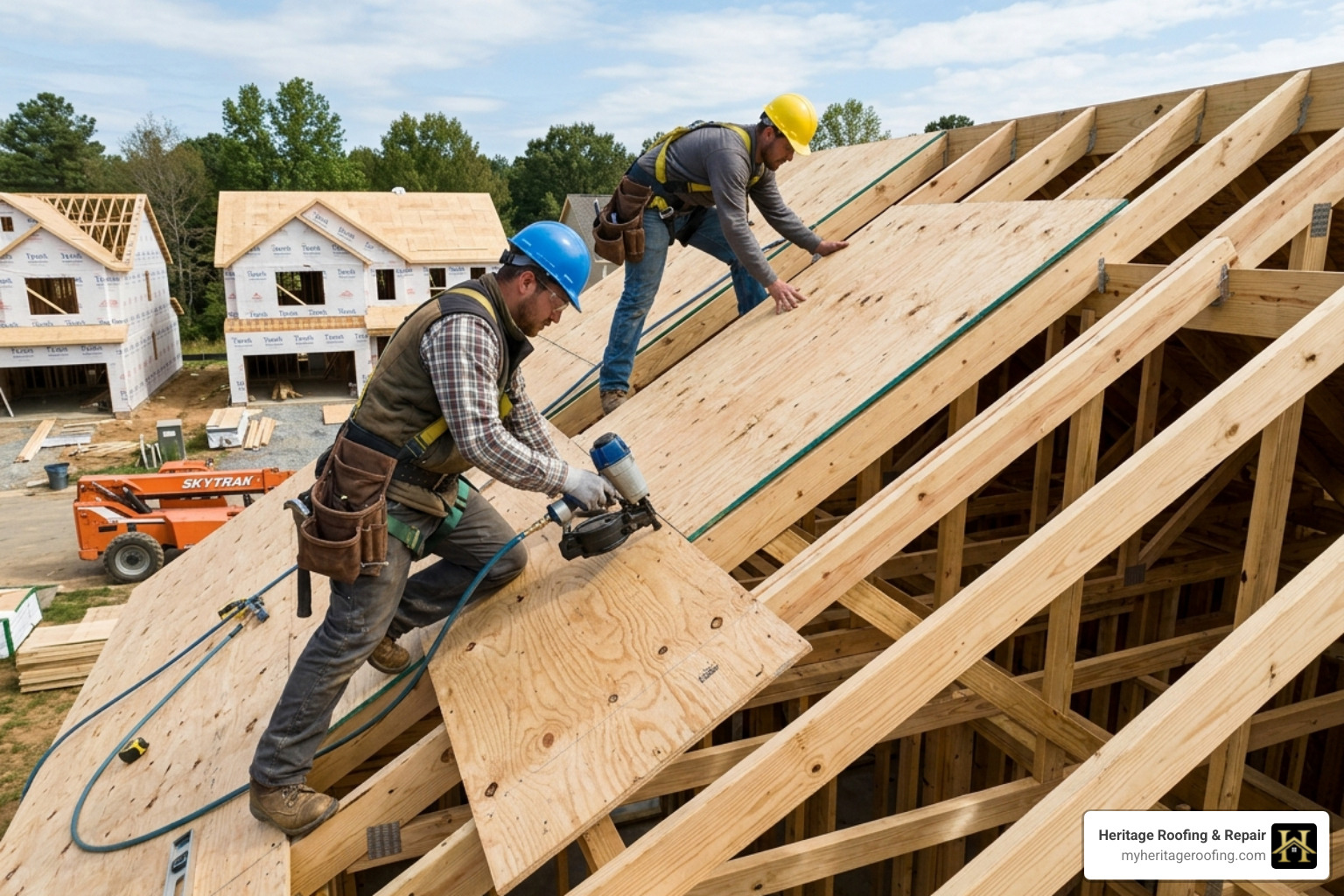
When we talk about roof deck repair, we are talking about the very bones of your roof. The roof deck, or sheathing, is the structural layer of boards that spans across your rafters. It serves as the “nailing surface” for your shingles and underlayment. Without a solid deck, your shingles have nothing to grip, and your home loses its primary defense against the elements.
Heritage Roofing & Repair
3458 Arkansas State Hwy 221, Berryville, AR 72616
Call: (870) 654-1164
In April 2026, most homes in Northwest Arkansas utilize either plywood or Oriented Strand Board (OSB) for this layer. It isn’t just a surface; it’s a load-bearing component that must support the weight of the roofing materials, snow loads, and even the weight of technicians performing maintenance. If you are curious about how this fits into the bigger picture, you can find more info about residential roof replacement on our service pages.
Defining the Structural Load Path
The “load path” is a fancy construction term for how weight travels through your house. Your shingles sit on the underlayment, which sits on the deck, which transfers that weight to the rafters or trusses. If the deck rots, that path is broken. This can lead to a “spongy” feel when walking on the roof or, in extreme cases, a total structural collapse of a section of the roof.
Identifying the Warning Signs of Roof Deck Damage
You don’t always need to climb a ladder to know you need roof deck repair. Often, the house will tell you something is wrong through subtle visual cues. One of the most common signs is “telegraphing,” where you can actually see the outline of the plywood or OSB panels through your shingles because the wood has warped or buckled. If you see this in Fayetteville, you should contact expert roofers in Fayetteville AR for a professional look.
| Symptom | Interior Sign | Exterior Sign |
|---|---|---|
| Water Intrusion | Dark stains on ceilings | Curled or missing shingles |
| Structural Decay | Sagging drywall or rafters | Dipping or “wavy” roofline |
| Biological Growth | Musty smells in the attic | Mold or moss on roof surface |
| Material Failure | Daylight visible through deck | Spongy feel underfoot |
Visual Cues from the Attic
The attic is the best place to perform a “no-ladder” inspection. Grab a flashlight on a sunny day. If you see “stars”—pinpricks of daylight—your deck or flashing has holes. Look for dark streaks or white, powdery mold on the underside of the wood. Rusted fasteners (nails) are also a dead giveaway that humidity is too high or a leak is present.
Exterior Indicators of Sheathing Failure
From the ground, look for a sagging roofline. A straight roof should be… well, straight. If it looks like it’s dipping between the rafters, the sheathing has likely lost its strength due to rot. You might also notice your gutters pulling away from the house; if the wood they are fastened to (the fascia and deck edge) is rotting, the heavy weight of water and debris will pull the hardware right out of the soft wood.
The Step-by-Step Process of Professional Roof Deck Repair
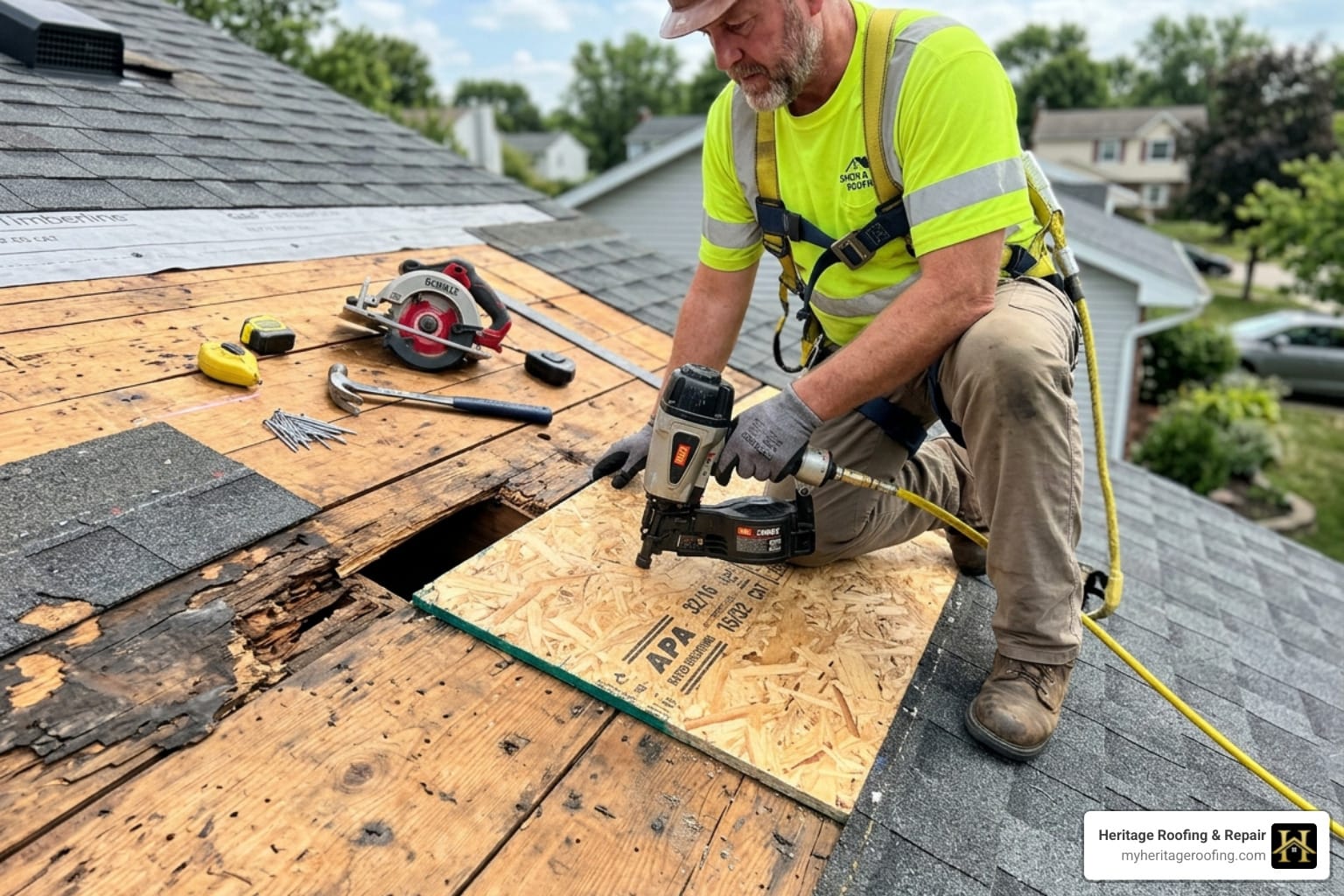
When we perform a roof deck repair, we don’t just slap a new board over the old one. That would be like putting a band-aid over a splinter—the rot will just keep spreading. According to the National Roof Repair Authority, proper repair requires cutting back to the center of the supporting rafters to ensure the new board has a solid “seat.”
- Inspection & Marking: We identify the soft spot and use chalk lines to mark a rectangular area that extends to the nearest rafters.
- Material Removal: We carefully remove shingles and underlayment, preserving what we can but ensuring the wood is fully exposed.
- The Cut: Using a circular saw set to the exact depth of the wood (to avoid cutting into the rafters!), we remove the damaged section.
- Rafter Inspection: Once the wood is out, we check the rafters for “sistering” needs. If the rafter is soft, we bolt a new piece of lumber alongside it for strength.
- Installation: We install a new panel of matching thickness (usually 7/16″ or 15/32″), using H-clips to allow for natural wood expansion.
- Fastening: We use corrosion-resistant nails, spaced 6 inches apart on the edges and 12 inches in the center, following IRC codes.
Assessing Minor vs. Major Roof Deck Repair Needs
We generally follow the “30-percent rule.” If more than 30% of your roof deck shows signs of deterioration, it is often more cost-effective to perform a full deck replacement rather than dozens of individual patches. For a better understanding of what happens during this process, check out our guide on what is replaced during a roof installation.
Structural Integrity and Roof Deck Repair Standards
Safety is non-negotiable. We follow OSHA standards and local building codes to ensure the repair area is extended 12-24 inches beyond the visible damage. This ensures we aren’t leaving behind any latent fungal rot that could return in a few months.
Material Comparison: OSB vs. Plywood for Roof Decking
Choosing the right material for your roof deck repair is a balance of budget and performance. Both have their place in Arkansas homes.
Why Plywood Remains a Premium Choice
Plywood is made of cross-laminated wood veneers. Its biggest advantage is moisture handling. If plywood gets wet, it swells uniformly and then shrinks back to its original size once dry. It has excellent fastener retention and a lifespan of 20-30 years. It is less likely to “delaminate” (separate into layers) than older versions of OSB.
The Economic Advantages of OSB
OSB is the “modern” choice. It is made of waterproof-heat-cured adhesives and rectangular-shaped wood strands. Because it’s manufactured in large mats, it is incredibly uniform—no knots or voids. It is generally $3 to $5 cheaper per sheet than plywood, making it a favorite for full replacements. However, if the edges get saturated, they can “mushroom” or swell, which might require more extensive roof deck repair later if leaks aren’t fixed quickly.
Cost Analysis and Insurance Coverage for Decking Repairs
How much should you set aside for roof deck repair? On average, you can expect to pay between $2 and $15 per square foot.
- Minor Repairs ($2-$5/sq ft): Small patches, replacing one or two sheets of plywood.
- Moderate Repairs ($5-$10/sq ft): Replacing multiple panels and reinforcing a few rafters.
- Extensive Structural Repairs ($10-$15/sq ft): Large scale rot removal, rebuilding sections of the roof frame, or high-pitch/difficult access work.
For a deeper dive into the total investment, see our comprehensive guide to roof replacement costs.
Factors Influencing the Final Quote
The “sticker price” is influenced by your roof’s pitch (steeper roofs require more safety gear and take longer), the height of your home, and the current cost of lumber. In 2026, material prices can fluctuate, but our 50 years of experience allows us to provide stable, honest estimates.
Navigating Insurance Claims for Storm Damage
In Berryville and Harrison, we see our fair share of hail and high winds. If a tree limb falls or hail cracks your sheathing, this is typically a “covered peril.” We specialize in professional advocacy, meeting with your insurance adjuster to point out hidden deck damage that they might miss from the ground. We provide the documentation needed to prove the damage was sudden and accidental, helping you get the coverage you deserve.
Preventing Future Deterioration through Maintenance
The best roof deck repair is the one you never have to do. Did you know that an inadequately ventilated attic can reduce your roof’s life by 24%? When heat and moisture get trapped in your attic, they bake the deck from the inside out, leading to “dry rot” and mold.
The Role of Proper Attic Ventilation
Your roof needs to breathe. Intake vents (at the eaves) and exhaust vents (at the ridge) create a “chimney effect” that pulls cool air in and pushes hot, moist air out. This prevents condensation from forming on the underside of your deck. If you’re noticing musty smells, it might be time to look into attic ventilation issues before your wood starts to rot.
Routine Inspection Schedules
We recommend a professional inspection at least once a year. After a major Arkansas storm, do a quick walk-around. Look for shingles on the lawn or “bruises” on your shingles from hail. Keeping your gutters clean is also vital; clogged gutters back up water under the first row of shingles, which is the #1 cause of edge rot on roof decks.
Our Commitment to Northwest Arkansas
At Heritage Roofing & Repair, we don’t just work in Berryville; we live here. Our deep roots in the community drive us to provide honest assessments and durable repairs for our neighbors. We treat every roof deck as if it were protecting our own families, utilizing local knowledge of Arkansas weather patterns to select the best materials and techniques for homes in Fayetteville, Harrison, and the surrounding Ozark region. Our goal is to ensure that every structural repair provides long-term stability and peace of mind for the homeowners we serve.
Frequently Asked Questions about Roof Decking
How much does roof deck repair typically cost?
Repair costs generally range from $2 to $15 per square foot. Minor patching for isolated leaks costs $2-$5, while extensive structural repairs involving rafters or large sections of sheathing can reach $10-$15 per square foot. Factors like roof steepness and material choice (plywood vs. OSB) will also impact the final price.
Can I perform a DIY roof deck repair?
While minor surface patches or filling a small hole with wood epoxy might be possible for experienced DIYers, any repair involving structural components, rotted rafters, or large sections of the deck should be handled by professionals. Working on a roof is dangerous, and improper repairs can void your shingle warranty or fail to meet local Arkansas building codes.
Will homeowners insurance cover my roof deck repair?
Insurance typically covers roof deck repair caused by sudden, accidental events like windstorms, hail, or fallen trees. However, they usually will not cover damage resulting from long-term neglect, such as a slow leak you ignored for three years or general wear and tear on an old roof. Professional documentation is key to a successful claim.
Conclusion
At Heritage Roofing & Repair, we believe in doing things right the first time. With over 50 years of experience in Berryville, Fayetteville, and Harrison, we’ve seen every type of deck failure imaginable. We don’t just fix the symptoms; we find the source of the moisture and ensure your home’s foundation is rock solid. Don’t wait for a small soft spot to become a major structural failure. Get a free roof replacement estimate or inspection today and protect your heritage for years to come.